
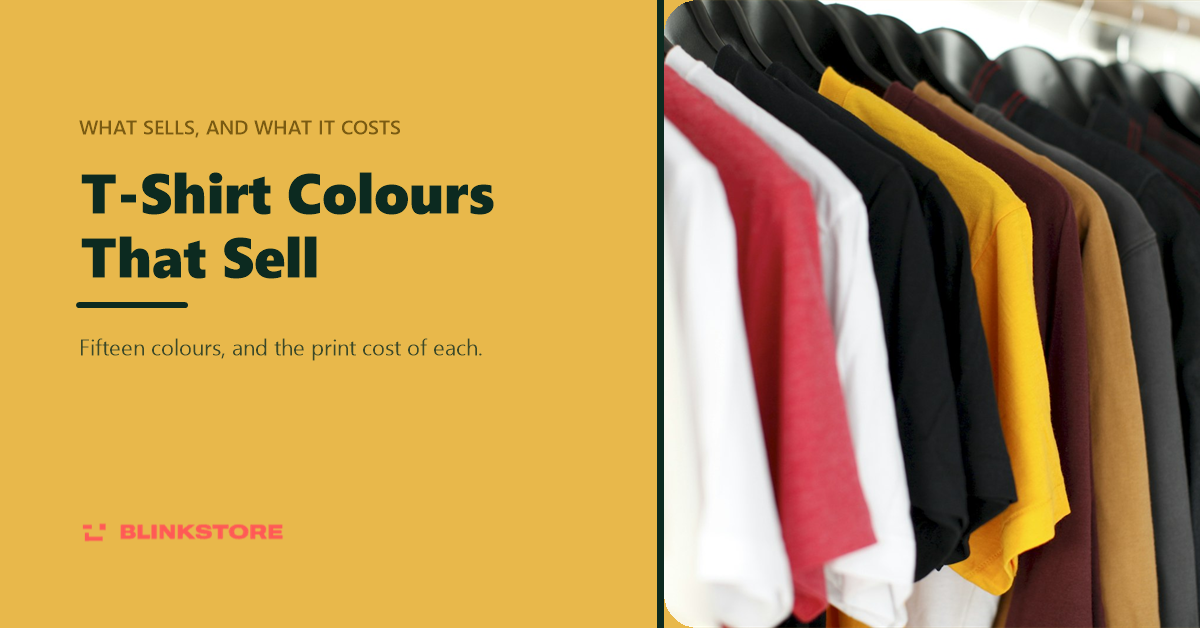
Black, white, navy and heather grey account for most printed t-shirt sales everywhere, and that holds in India too. What changes here is the rest of the list: lighter shades sell disproportionately well because of the climate, and the colour you choose quietly changes what your print costs and which methods will work at all.
Most articles on this are a ranked list of colours with no reasoning attached. A colour is not only a taste decision. It decides whether your printer needs a white underbase, whether sublimation is available to you, and whether your design is visible at thumbnail size.
The 15 t-shirt colours that actually sell
Ranked roughly by volume, with why each one earns its place.
- Black — the consistent number one. Flattering, hides marks, and makes bright artwork pop.
- White — cheapest to print on, coolest to wear, and the default for summer in India.
- Navy — the safe alternative to black. Reads smarter and less severe.
- Heather grey — the most-bought neutral after black and white. Works on almost any design.
- Charcoal / dark grey — black’s softer twin, and better in photographs.
- Beige and sand — the neutral that has grown fastest, and it suits Indian skin tones well.
- Olive green — strong with men’s streetwear and oversized fits.
- Maroon — a long-standing favourite in India, particularly for college and group orders.
- Sky blue — light, summer-friendly, sells well in the south and west.
- Mustard yellow — the accent colour that moves, especially in festive ranges.
- Red — event, sports and group merchandise. Rarely an everyday seller.
- Baby pink — strong across women’s and unisex, and no longer gendered in practice.
- Lavender — the pastel that has crossed over into mainstream demand.
- Cream / off-white — the premium version of white. Photographs beautifully.
- Bottle green — niche, but reliably chosen when it is offered.
If you offer only four, make them black, white, navy and heather grey. Those four will carry the large majority of your orders and nothing else comes close.
What each t-shirt colours costs you to print on
This is the part left out of every colour list, and it affects your margin on every single order.
| Garment | DTG | DTF | Sublimation | Screen |
|---|---|---|---|---|
| White | Cheapest. No underbase, no pre-treatment. | Fine | Only on polyester | Cheapest |
| Light colours | Cheap. Minimal pre-treatment. | Fine | Only on polyester, and the base colour shows through | Cheap |
| Dark and black | Costs more. Needs pre-treatment and a white underbase, which uses more ink and takes longer. | Fine — the transfer carries its own white | Not possible. Sublimation has no white ink. | Needs a white underbase layer |
| Heather | Blend has polyester in it, so colour sits slightly duller | Fine | Depends on the blend | Fine |
Three practical consequences. Black shirts are the best seller and the most expensive to print, so check your margin holds on them specifically. If you print by sublimation, dark garments are simply off the menu. And if you want one method that treats every colour the same, that is DTF — the reason it has become the default for small sellers. The fabric side of that decision is in cotton polyester blend fabric.
What changes in India
The international lists are written for temperate markets, and three things genuinely differ here.
- Light colours sell harder in summer. White, sky blue, beige and cream move disproportionately from March to June, for the obvious reason that black absorbs heat. Plan your colour mix seasonally rather than fixing it once.
- Beige, maroon and mustard over-index. All three sit well against Indian skin tones and appear far more often in Indian wardrobes than in Western bestseller lists.
- Festive ranges have their own palette. Diwali and wedding-season merchandise leans on maroon, mustard, bottle green and cream rather than the year-round neutrals.
One more that catches sellers out: black shows sweat and dust more visibly in Indian conditions than it does in cooler climates. It still outsells everything, but it generates more “the colour faded” messages, which is usually washing rather than fading.
How many t-shirt colours to offer
Fewer than you think. Every extra colour multiplies your mockups, your listing images and, if you hold stock, your inventory risk across every size.
| Stage | Offer |
|---|---|
| Testing a new design | One colour. Black or white, whichever suits the artwork. Find out if the design sells before you multiply it. |
| Design is proven | Three or four. Black, white, navy, heather grey. |
| Design is a bestseller | Six to eight. Add beige, olive, maroon and one seasonal shade. |
| Festive range | Two or three in the festive palette only. These are short-lived. |
With print on demand there is no stock penalty for offering more colours, but there is still a listing penalty: eight colours means eight mockups to make and a buyer who has to make a decision instead of clicking buy. Start narrow anyway.
Designing for the garment colour
- Test your design on white and black before anything else. If it survives both, it will survive the rest.
- Watch white elements on white garments. Outlines and highlights vanish, and that is where most of the “my print looks wrong” complaints come from.
- Dark artwork on dark shirts loses contrast at thumbnail size, which is where the click happens, not in the buyer’s hands.
- Heather fabrics show through slightly. The texture reads through lighter ink, so solid flat colour looks less solid than it does on a plain garment.
- Design once with transparency handled properly so the same file works across every colour without re-editing.
If you are selling online, show the design on the colour you expect to sell most, not the one that photographs best. A buyer who orders black expecting the white-shirt photo is a return waiting to happen.
Colour is one of the few decisions in this business you can change for free. If you print on demand, list a second colour, watch for a month, and let the orders tell you. Print on demand websites in India let you add colour variants without holding any of them as stock, and types of t-shirts covers the cut, which matters as much as the shade.
T-shirt colour FAQs
What are the most popular t-shirt colours to sell?
Black, white, navy and heather grey account for the large majority of printed t-shirt sales. After those, charcoal, beige, olive, maroon and sky blue are the most consistent sellers, with mustard and pink performing well as accent colours.
Which t-shirt colour sells best in India?
Black still leads, but light colours sell disproportionately well here because of the heat, particularly white, sky blue, beige and cream from March to June. Maroon and mustard also over-index in India compared with Western bestseller lists.
Does t-shirt colour affect printing cost?
Yes. On DTG, dark garments need pre-treatment and a white underbase, which uses more ink and takes longer, so black costs more to print than white. Sublimation cannot print on dark garments at all because there is no white ink. DTF treats all colours the same.
How many t-shirt colours should I offer?
One while you are testing a design, three or four once it sells, and six to eight only for proven bestsellers. Every extra colour means another mockup and one more decision for the buyer, so start narrow even when stock is not a constraint.
Can you print on black t-shirts?
Yes, with DTG, DTF or screen printing, all of which lay down a white underbase first. You cannot print on black with sublimation, because sublimation has no white ink and the dye needs a light polyester surface to bond into.
What colour t-shirt is best for printing?
White is cheapest and simplest on every method. Black is the best seller and makes bright artwork stand out, at a slightly higher print cost. If you only test on one, test on the colour you actually expect to sell most.
Why does my design look faded on a heather t-shirt?
Heather fabrics are cotton and polyester blends with a visible texture, so ink sits slightly duller and the weave reads through lighter colours. It is normal rather than a defect, but worth allowing for when you pick artwork for heather variants.
Which colours work for festive collections in India?
Maroon, mustard, bottle green and cream rather than the year-round neutrals. Festive ranges are short-lived, so offer two or three colours only and prepare them well before the date rather than during it.
