
A working print setup in India starts near ₹50,000 for a heat press and a sublimation printer, around ₹1,50,000 for a DTF line, and past ₹5,00,000 for production DTG. Before any of it, run one number: printing services charge roughly ₹35 to ₹100 a piece, so a ₹1,50,000 setup needs a few thousand orders before owning beats outsourcing.
Every guide on this subject lists machines and prices. Very few answer the question that decides whether any of it was a good idea: at your order volume, should you own a machine at all? This one covers both, with Indian street prices, the running costs that never appear in a quotation, and the arithmetic.
The five machines, and what each one is actually for
Apparel print on demand runs on five methods. They are not interchangeable. The fabric you sell on decides which will work at all, and the order size decides which is affordable.
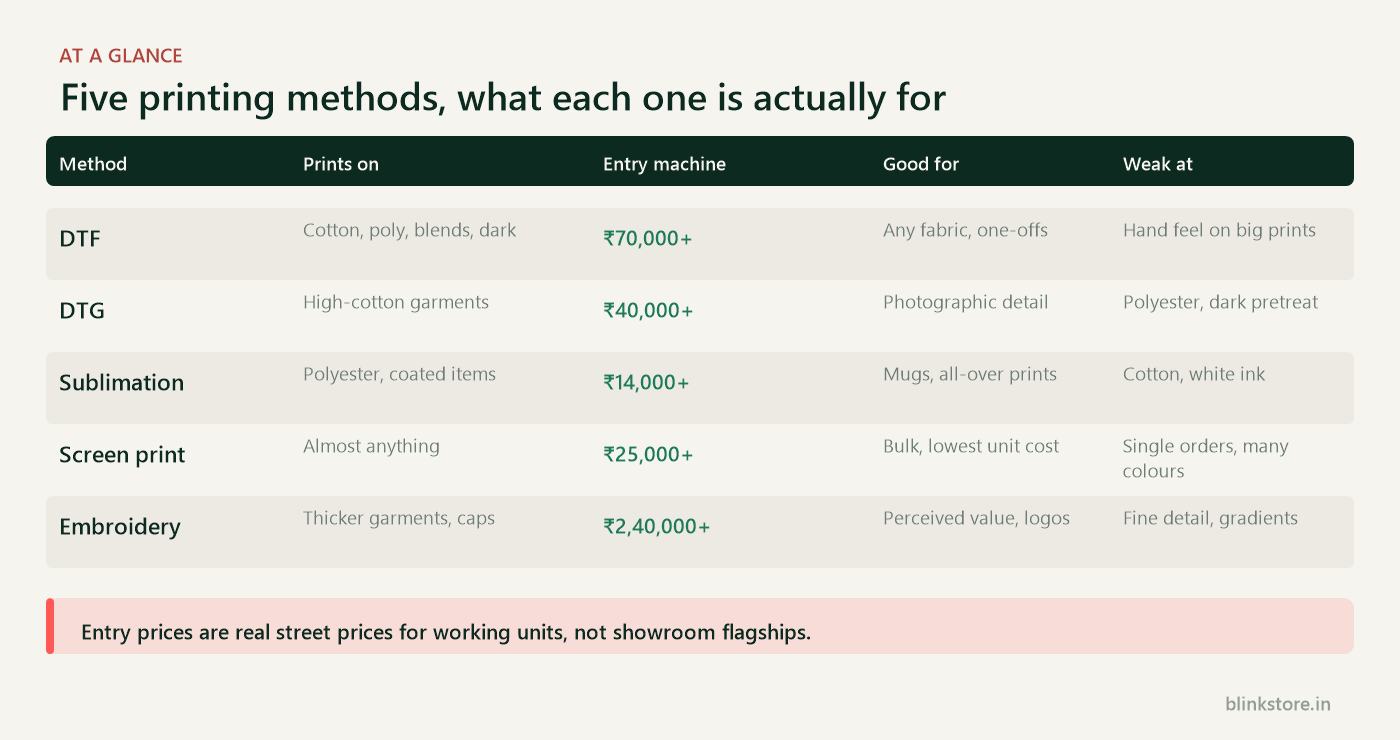
Two notes before the detail. First, most lists of “print on demand machines” quietly omit DTF, which is the cheapest method that will print on any fabric and any colour. Leaving it out pushes a beginner towards a ₹5,00,000 DTG machine they do not need. Second, puff is not a machine. It is an additive in screen or DTF ink that expands under heat, so it is an effect you add to a method you already own.
DTF: the cheapest method that prints on anything
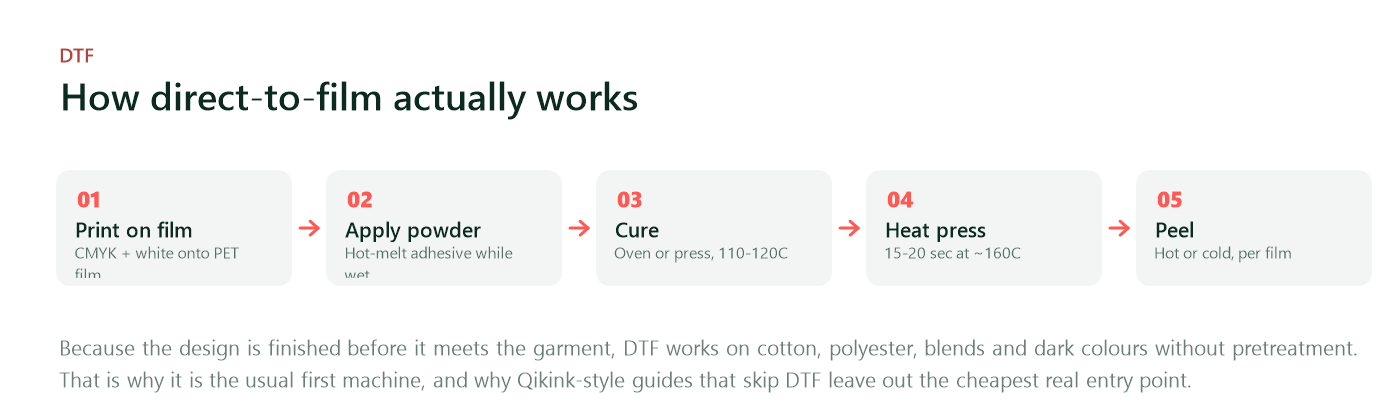
Direct to film prints the design onto a PET sheet, coats it in hot-melt adhesive powder while the ink is wet, cures it, and heat-presses it onto the garment. Because the transfer is finished before it touches fabric, DTF does not care whether the garment is cotton, polyester, a blend, white or black.
What it costs in India
- A3 desktop DTF: from about ₹70,000. Converted desktop units at the bottom, purpose-built A3 machines around ₹2,50,000.
- 60cm roll-to-roll: roughly ₹4,50,000 to ₹7,50,000. A dual or quad head i3200-A1 machine for garment factories runs ₹5,50,000 to ₹8,50,000.
- A full commercial line with an automatic powder shaker and curing dryer: about ₹2,50,000 to ₹7,00,000 all in.
- UV DTF 60cm (for hard surfaces rather than fabric): around ₹10,00,000.
What it costs to run
This is where DTF earns its reputation. Running cost sits around ₹35 to ₹45 per A3 sheet of transfers, and a single A3 sheet usually carries more than one design. Shops selling finished A3 transfers price them at roughly ₹60 to ₹80, which tells you the margin is real but not enormous.
Consumables are PET film, hot-melt adhesive powder and textile pigment ink. Buy a machine that takes open inks rather than encrypted cartridges, because the encrypted systems are where the long-term cost hides.
What goes wrong
- Powder applied unevenly leaves a visible halo around the print. An automatic shaker fixes this and a manual tray does not, reliably.
- Under-curing shows up three washes later, not on day one, so you will not catch it during testing unless you deliberately wash-test.
- White ink settles. Machines left idle for a week need a circulation routine or the white line clogs.
- Large solid prints have a noticeable hand feel. For a full-front design on a soft tee, DTG still wins on finish.
If you are only ever going to own one machine, this is usually it. Our breakdown of t-shirt printing cost goes through the per-piece numbers in more detail.
DTG: the best finish, and the hardest to own
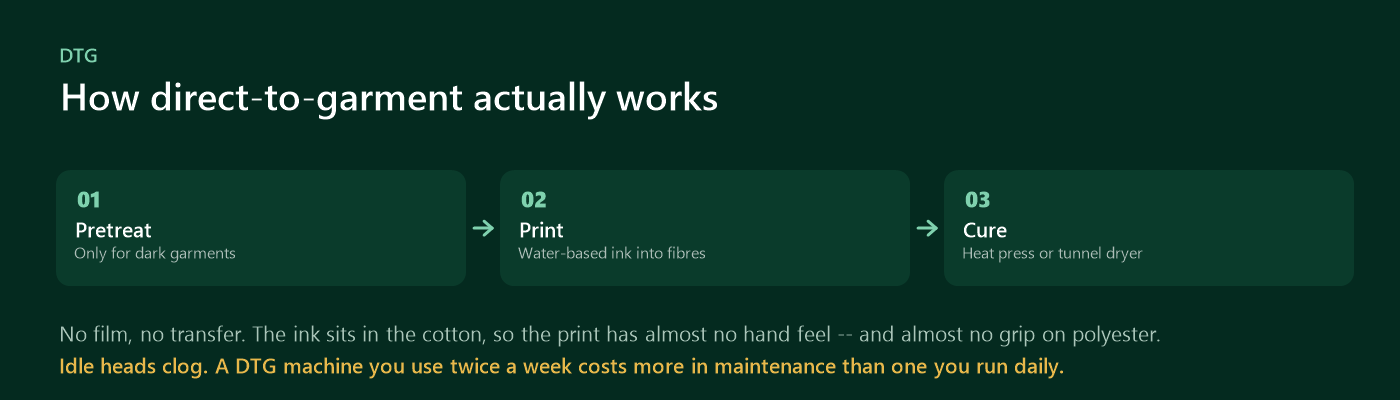
Direct to garment sprays water-based ink straight into the fibres. There is no transfer sitting on top, so a good DTG print has almost no hand feel and handles photographic detail and gradients better than anything else on this list.
What it costs in India
- Entry and converted desktop units: ₹40,000 to ₹2,00,000, realistically 10 to 30 shirts a day.
- Mid-range commercial: ₹3,50,000 to ₹8,00,000, good for 100 to 300 shirts a day.
- Industrial: ₹10,00,000 to ₹24,00,000 and up, 500+ shirts a day.
Named machines, so the tiers are concrete: Ricoh Ri 100 around ₹2,50,000 to ₹3,50,000; Ricoh Ri 1000 and Ri 2000 around ₹8,50,000 to ₹13,00,000; Epson SureColor SC-F2230 around ₹10,00,000 to ₹11,80,000; Brother GTXpro about ₹14,00,000; Brother GTXpro B about ₹20,00,000 to ₹24,00,000.
What goes wrong
- Idle time kills DTG. Printheads clog when the machine sits unused. A DTG printer run twice a week costs more in maintenance and wasted ink than one run daily.
- Printhead replacement on an entry machine runs roughly ₹20,000 to ₹50,000. On a commercial machine it is a different order of magnitude entirely.
- Pretreatment is a second process. Dark garments need pretreat fluid applied, pressed and dried before printing. Done badly it leaves a visible square around the design.
- Polyester does not take it. High-cotton garments only, which rules out most sportswear.
DTG makes sense when you already have steady daily volume on cotton. It is a poor first machine for someone testing whether their designs sell.
Sublimation: cheapest to start, narrowest in what it can do
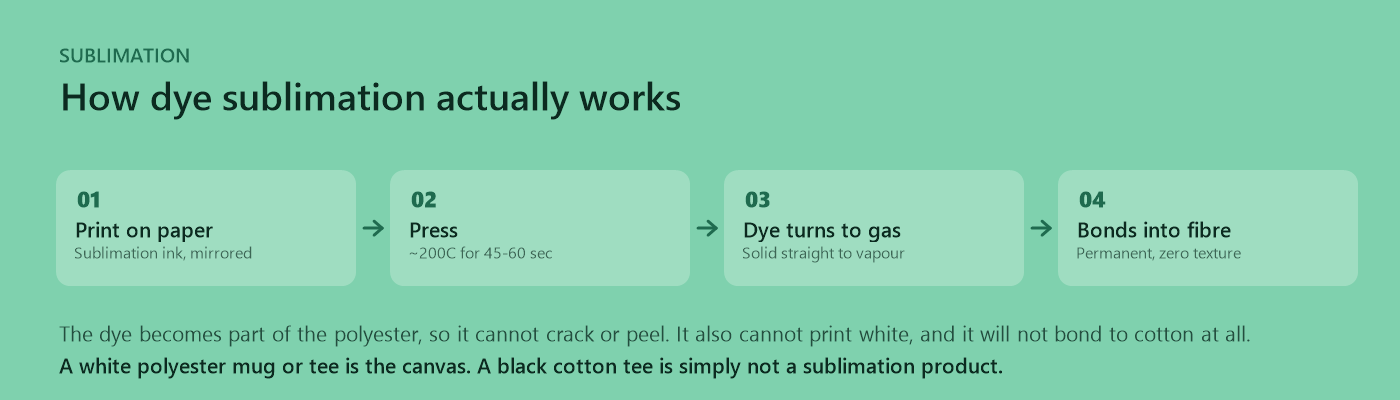
Sublimation ink is printed onto transfer paper, then heat turns the dye straight from solid to gas so it bonds inside polyester fibres. The result cannot crack or peel because it is not sitting on the surface, it is part of it.
What it costs in India
- A4 desktop: Epson EcoTank L3250 around ₹13,899, L3266 around ₹13,999. Converted EcoTanks are how most Indian sellers start.
- A3: Epson EcoTank L1300 around ₹29,999, L18050 A3+ around ₹33,699.
- Purpose-built: Epson SC-F130 around ₹28,000 to ₹34,000; SC-F530 24 inch around ₹1,40,000 to ₹1,60,000; SC-F6430 44 inch around ₹3,80,000 to ₹4,20,000.
The two limits that decide everything
Sublimation cannot print white. Anything white in your artwork is simply the colour of the substrate showing through, which is why every sublimation product you have seen is on a white or very light base. And it will not bond to cotton at all. A 100% cotton tee is not a sublimation product, no matter what the listing says.
What it is excellent at: mugs, coasters, mousepads, phone cases, polyester sportswear and all-over prints where the design runs off the edge of the garment. If your catalogue is mugs and polyester, this is the cheapest serious entry on the list.
Screen printing: lowest cost per piece, worst fit for print on demand
Ink is pushed through a stencil, one screen per colour. It is the oldest method here and still the cheapest per unit once the run is long enough, because the cost sits in setup rather than in each print.
What it costs in India
- Manual flatbed: ₹25,000 to ₹1,50,000.
- Semi-automatic: ₹1,50,000 to ₹5,00,000.
- Fully automatic: ₹5,00,000 to ₹25,00,000.
The economics are the opposite of print on demand. Every colour needs its own screen, and every screen needs making, coating, exposing and reclaiming. A four-colour design on a run of ten pieces is uneconomic. The same design on a run of five hundred is cheaper than anything else here.
So screen printing belongs in a POD business as the thing you graduate to for your bestsellers, not as the thing you start with. If a design is reliably selling a few hundred a month, moving it to screen print is where the margin is.
Embroidery: the one that changes what you can charge
Thread, not ink. A computerised machine stitches the design from a digitised file, and the perceived value is noticeably higher than a print, which is why corporate and uniform work leans on it.
What it costs in India
- Single head, computerised: roughly ₹2,40,000 to ₹5,50,000. Basic models start near ₹3,40,000.
- Premium single head: a Brother PR 1050X sits near ₹7,90,000.
- Typical spec at this level: 12 needles, speeds to about 1,200 stitches per minute.
Two costs people miss. Every design must be digitised into a stitch file, which is a skill you either buy per design or learn. And stitch count, not design size, drives time and cost, so a dense fill costs far more to run than a line-art logo of the same dimensions.
Embroidery also fails at things print handles easily: fine detail, gradients, photographs and very small text. It is a logo and lettering method.
What each machine actually costs in India
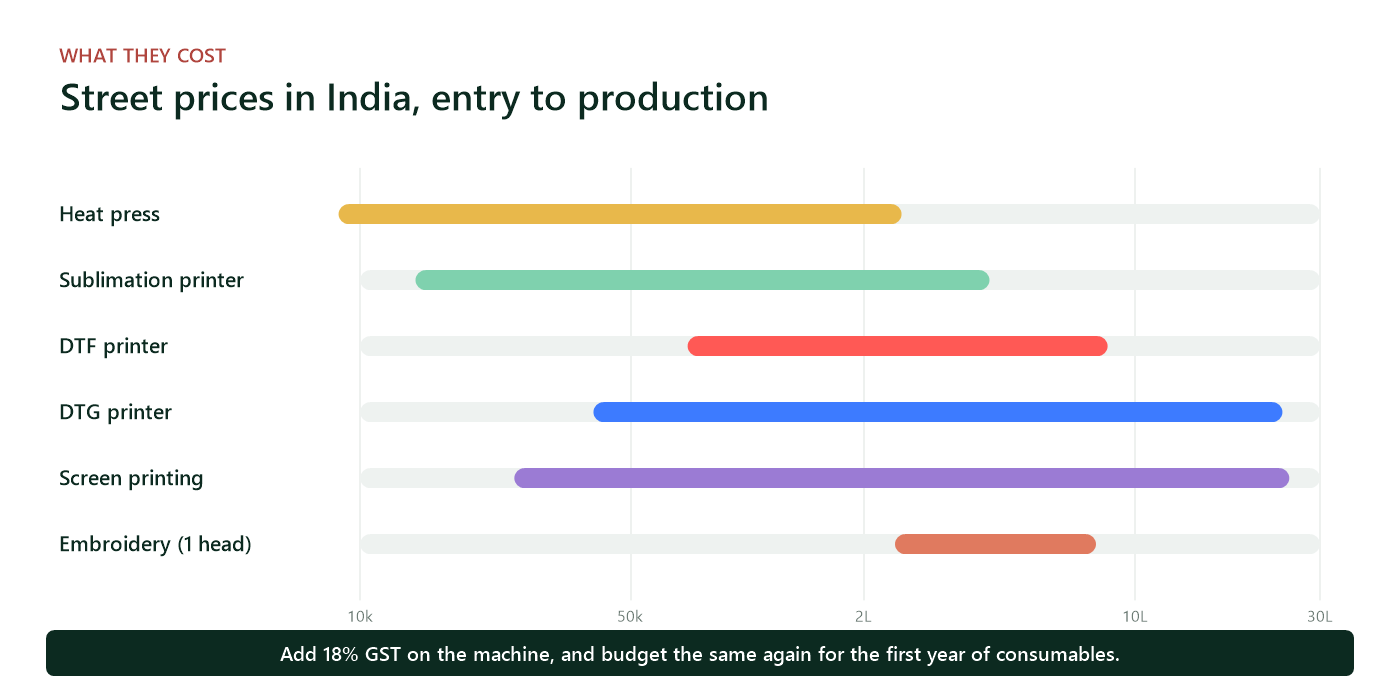
Those ranges are wide because one category covers a converted desktop printer and a production machine. Read the bottom of each range as “works, slowly, with limits” and the top as “runs a full shift”. Add 18% GST on the machine, and if you finance it, the EMI interest on top.
The equipment nobody puts in the budget
Almost every quotation covers the printer and stops. These are the pieces that turn a printer into a working line.
- Heat press. Non-negotiable for DTF, sublimation and vinyl. A 15×15 inch manual press runs about ₹8,800 to ₹25,000; auto-open and pneumatic presses cost considerably more and save your wrists at volume.
- Powder shaker and curing dryer. For DTF. Doing this by hand with a tray and a heat gun works for ten pieces a day and stops working above that.
- Pretreatment machine. For DTG on darks. A spray gun is the cheap route and gives uneven coverage; a proper pretreat unit is consistent.
- RIP software. Drives colour separation, white underbase and ink limits. The bundled driver is rarely enough once you care about colour accuracy.
- Exhaust and ventilation. Curing adhesive powder and pretreatment fluid both put fumes into the room. This is a health item, not an optional extra.
- A heat gun, teflon sheets, a tack-down pad and spare platens. Small money, and you will buy them in week one anyway.
The costs nobody quotes you
The machine price is the smallest line on the list.
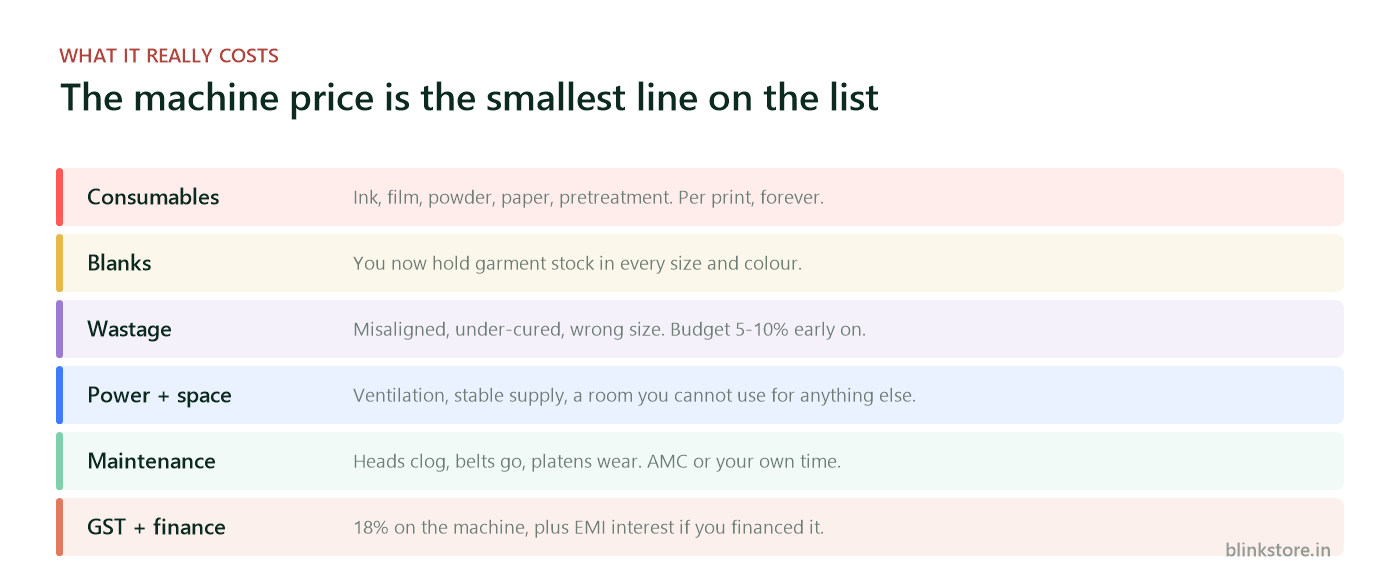
The one that surprises people most is blanks. The moment you print in-house, you are holding garment stock in every size and colour you offer, which is precisely the inventory risk that print on demand existed to remove. Our piece on print on demand profit margins works through what is left after all of this.
Buy or outsource: do this arithmetic first
Printing services in India charge roughly ₹35 to ₹100 a piece depending on method, size and volume. Owning converts that per-piece cost into a fixed cost plus a smaller per-piece cost. The question is only where the two lines cross.
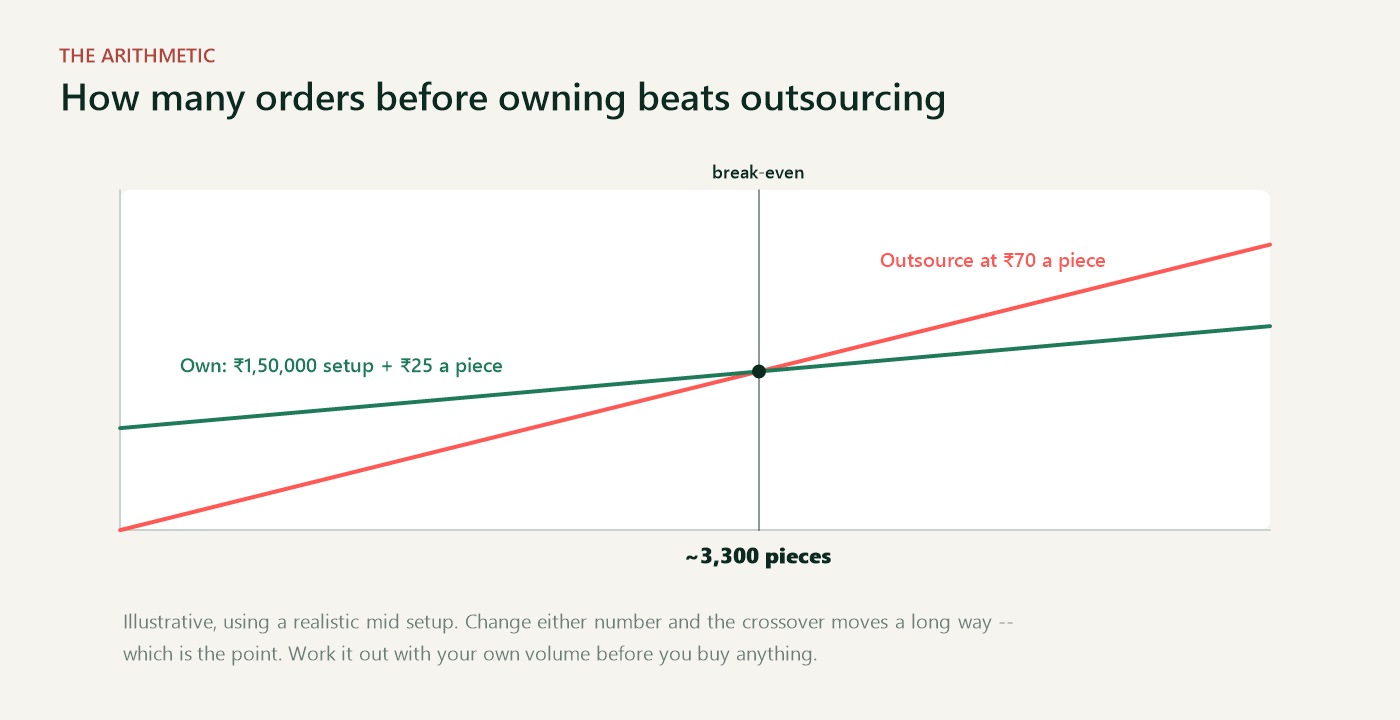
Three things this chart does not show, and all three favour outsourcing early on:
- Your time. Printing, curing, quality-checking and packing is a job. If you are also the person doing marketing and customer service, the machine is competing with the work that actually grows the business.
- Learning curve waste. The first few hundred prints include misalignments, under-cures and ruined blanks. Budget 5 to 10% wastage in the first months.
- Flexibility. A printing partner can produce a hoodie, a mug and a tote on the same order. One machine does one category.
If you are still validating designs, outsource. Platforms like print on demand India print and ship each order as it comes, so you find out which designs sell before you have capital tied up in a machine. The guide to best print on demand sites in India covers the alternatives.
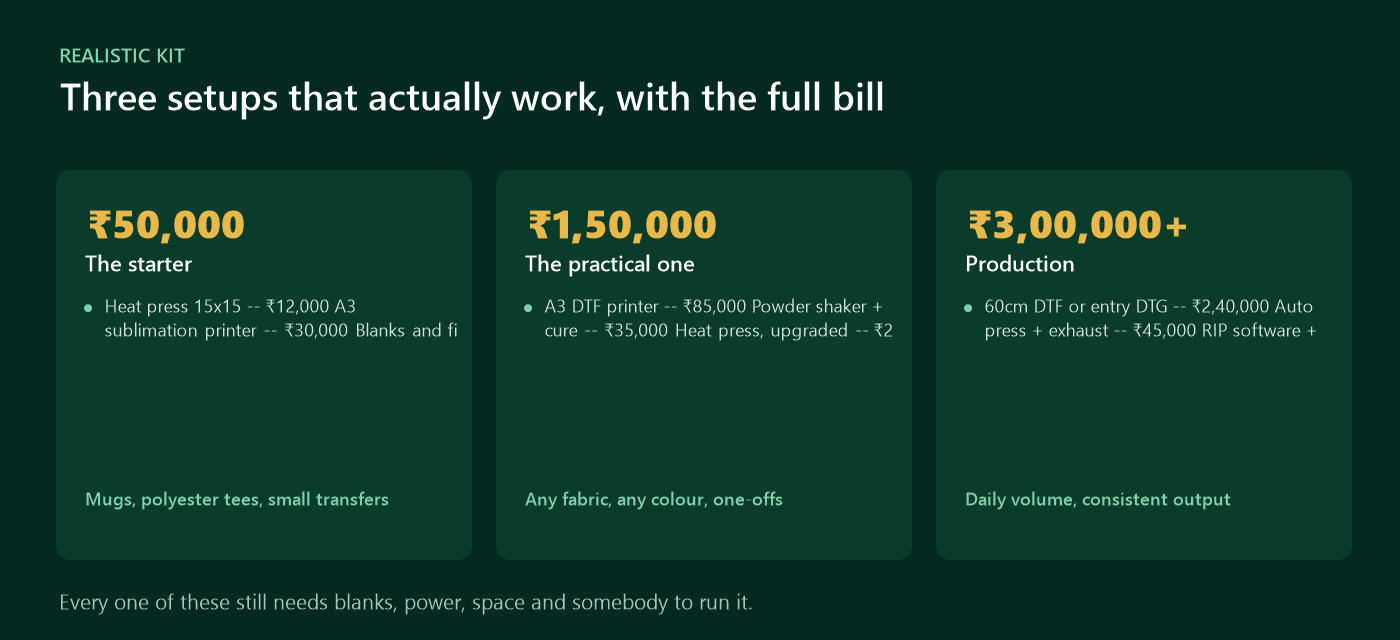
Three setups that actually work
Around ₹50,000: the starter
A 15×15 heat press and an A3 sublimation printer, plus a first batch of blanks and paper. This prints mugs, polyester tees and small transfers. It will not print on cotton and it will not print white, so pick the catalogue to suit the machine rather than the other way round.
Around ₹1,50,000: the practical one
An A3 DTF printer, a powder shaker with curing, and a better heat press. This handles any fabric, any colour, in any quantity down to one. If you are buying one setup and you do not know yet what you will be printing, this is the one that keeps the most doors open.
₹3,00,000 and up: production
A 60cm DTF line or an entry commercial DTG, an auto-open press, extraction, RIP software and spares. At this level the machine needs to run most days to justify itself, which means you need the order flow before you buy, not after.
How not to get burned when you buy
- Demo on your own garment. Take your actual blank and your actual artwork to the showroom. A demo on the dealer stock proves nothing about your fabric.
- Wash-test the sample. Five washes. Most print failures show up at wash three, not on the day.
- Ask whether the inks are open or encrypted. Encrypted cartridge systems lock you into one supplier at their price for the life of the machine.
- Check the service network in your city. A printhead failure with a two-week parts lead time is two weeks of no production.
- Get a GST invoice. 18% is claimable against output tax if you are registered, and the cash-deal price is rarely the saving it looks like.
- Ask the per-print consumable cost in writing, not the machine price. The machine is a one-time number; this one repeats forever.
Print on demand machine FAQs
How much does a print on demand machine cost in India?
A heat press runs ₹10,000 to ₹45,000, a sublimation printer ₹15,000 to ₹60,000, a DTF printer ₹60,000 to ₹3,00,000 and a DTG machine ₹2,00,000 to ₹5,00,000 or more. Industrial textile printers start around ₹10,00,000.
Should I buy a printing machine or outsource?
Outsource below roughly 300 orders a month. Printing services charge about ₹35 to ₹100 a piece, so a ₹50,000 setup needs around 830 orders just to cover the machine, before consumables, blanks, wastage and your own time. Buy once volume is consistently high.
What is a puff printing machine?
Puff is an ink additive that expands under heat to give a raised, textured print. It is applied through screen printing or DTF rather than by a dedicated machine, so the cost usually sits between ₹17,500 and ₹1,45,000 as part of a wider setup.
Which printing machine is best for t-shirts?
DTF for most small sellers, because it prints on cotton, blends and dark fabric and is forgiving to operate. DTG gives the softest result on cotton but costs far more and needs daily maintenance. Sublimation cannot print on cotton at all.
What is the cheapest way to start a printing business in India?
Do not buy equipment. Use a print-on-demand partner so the printing, packing and shipping are handled per order, and spend your money on designs and marketing instead. Equipment makes sense once orders are consistent, not before.
How much does puff printing cost per piece in India?
Printing services quote roughly ₹35 to ₹100 a piece depending on print size and method. That figure is also the benchmark to compare against when you are deciding whether buying a machine is worthwhile.
Do I need a heat press for print on demand?
Only if you are printing yourself. A heat press is the common piece across DTF, sublimation, vinyl and puff transfers, so it is usually the first purchase. If a partner prints for you, you need no equipment at all.
What are the hidden costs of owning a printing machine?
Consumables per print, garment blanks in every size and colour, wastage from misprints, space and power, maintenance on print heads that clog when idle, and your own hours spent printing and packing instead of selling.
DTF or DTG: which should I buy first?
DTF, in almost every case. It starts around ₹70,000 against ₹40,000 to ₹2,00,000 for a converted desktop DTG, and more importantly it prints on cotton, polyester, blends and dark garments without pretreatment. DTG gives the better finish on soft cotton tees, but it only pays off once you have steady daily volume, because idle printheads clog.
How much does a DTF print cost to produce?
Roughly ₹35 to ₹45 per A3 sheet of transfers in film, powder and ink, and one A3 sheet usually carries more than one design. Shops selling finished A3 transfers price them at about ₹60 to ₹80, which is a reasonable sanity check on the margin. That figure excludes the blank garment, your time and wastage.
What does an embroidery machine cost in India?
A computerised single-head machine runs roughly ₹2,40,000 to ₹5,50,000, with basic models near ₹3,40,000 and premium units such as the Brother PR 1050X near ₹7,90,000. Typical specification at that level is 12 needles and speeds to about 1,200 stitches per minute. Budget separately for digitising each design into a stitch file.
Can I claim GST on a printing machine?
If you are GST registered, the 18% charged on the machine is input tax credit you can set against your output tax, so the real cost is the ex-GST price. That only works with a proper tax invoice in your business name, which is why a cash deal at a small discount is usually worse than it looks.
Machine prices are Indian street prices gathered from dealer and marketplace listings in October 2026 and move with the rupee, the printhead market and GST treatment. Confirm against a live quotation before you buy. Running costs are typical figures, not guarantees.
