
Choose an ecommerce platform by starting from your business, not the feature list. Decide whether you need a marketplace, a store builder or print-on-demand; work out your real monthly cost including payment and transaction fees; then check it handles GST, COD and Indian shipping. Most small sellers overpay because they skip step two.
Every guide to picking an online store platform gives you the same checklist: scalability, SEO, integrations, support. All true, all useless, because every platform claims all four.
The questions that actually decide it are narrower and more awkward. What will this cost me at the revenue I am at now, not the revenue I hope for? Who owns the customer? What happens when I want to leave? This guide answers those, with real Indian numbers checked in September 2026.
First, decide what kind of platform you need
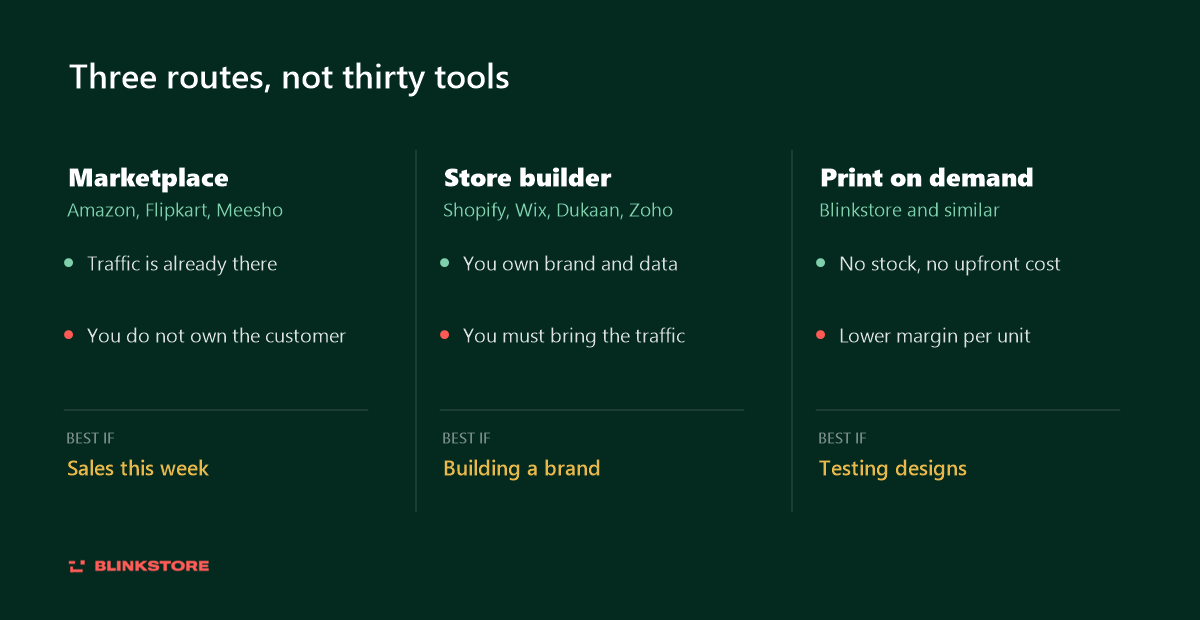
“Ecommerce platform” means two completely different things in India, and choosing between them matters far more than choosing between brands.
A marketplace (Amazon, Flipkart, Meesho) is somebody else’s shop where you rent shelf space. A store builder or ecommerce software (Shopify, Wix, Dukaan, Zoho Commerce, WooCommerce) is your own shop that you have to bring people to. A print-on-demand setup sits alongside either, removing stock from the equation entirely.
Most people searching for the best ecommerce platform for online business are really trying to work out which of these three routes they are on.
The seven questions that actually decide it
1. What are you selling, and how many SKUs?
Ten products with three variants each is a different problem from 2,000 SKUs. Below about 50 SKUs almost any platform copes and you should optimise for speed of setup. Above a few hundred, catalogue management, bulk editing and inventory sync stop being nice-to-haves.
2. What is your monthly revenue right now?
Not your target. Your current number. Platform pricing is built so that the cheapest plan stops being cheapest at a certain revenue, and most sellers never recalculate. There is real money in this, and the section below works it out.
3. Who needs to own the customer?
On a marketplace, the buyer is the marketplace’s customer, not yours. You get an order, rarely a relationship. On your own store you get the email address, the repeat purchase and the ability to run your own retention. If you are building a brand rather than shifting units, this single question usually settles the decision.
4. Where will the traffic come from?
This is the one people get wrong. A store builder gives you a shop; it does not give you shoppers. If you have no audience and no ad budget, a marketplace’s existing footfall is worth more than a beautiful storefront nobody visits. Be honest about which you have.
5. Does it handle Indian payments properly?
Check three things specifically: UPI, cash on delivery, and GST-compliant invoicing. COD still accounts for a large share of Indian ecommerce orders, and a platform that handles it awkwardly will cost you sales. Also check how returns and COD remittance work, because that is where cash flow gets painful.
6. What does it cost to leave?
Ask before you join. Can you export your product catalogue, your customers and your order history in a usable format? Do your URLs carry over? On open-source software you own everything; on hosted platforms you are exporting what they let you export. Migration pain is the cost nobody prices in.
7. Can you actually run it?
Self-hosted ecommerce software is cheaper on paper and more expensive in practice, because you are now responsible for hosting, updates, security patches and breakages. If nobody on your team enjoys that work, a hosted SaaS platform is genuinely cheaper.
What an ecommerce platform really costs in India
Here is the part most comparison articles skip, because it is uncomfortable. The subscription is rarely your biggest cost.
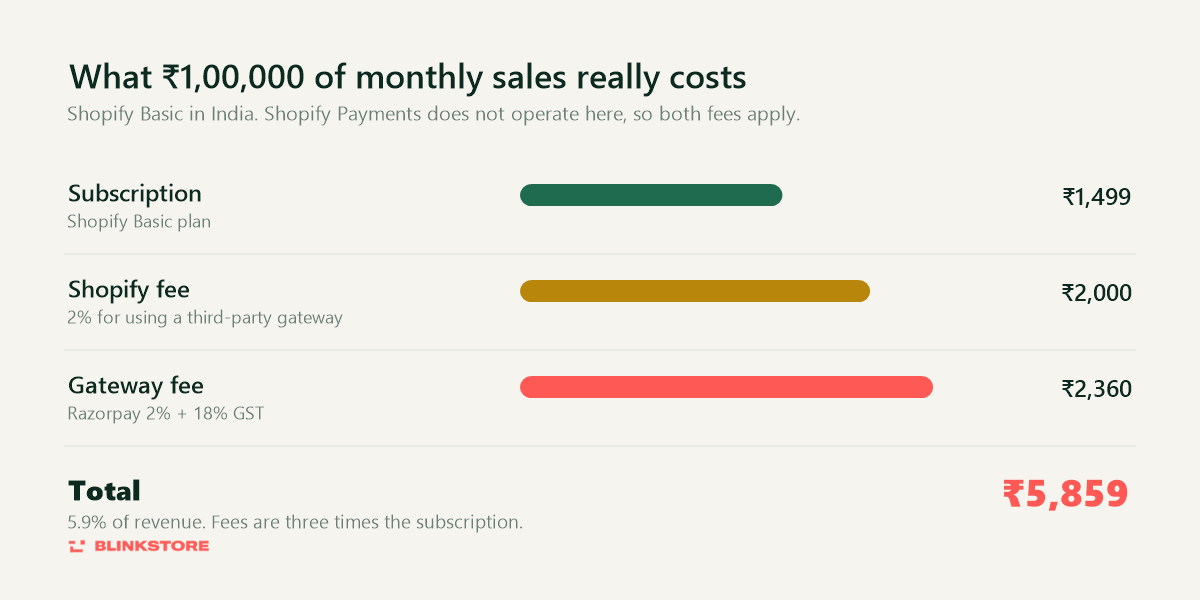
Shopify Payments does not operate in India. That single fact changes the maths. Indian merchants have to use a third-party gateway such as Razorpay, PayU or CCAvenue — and Shopify charges an additional transaction fee when you do: 2% on Basic, 1% on Grow, 0.6% on Advanced. You pay that on top of what the gateway charges.
Razorpay’s standard domestic rate is 2% across cards, UPI, netbanking and wallets, with no setup or annual fee, and 18% GST applies on the fee itself — so the real rate is about 2.36%.
Put together, a Shopify Basic store in India doing ₹1,00,000 a month pays roughly ₹5,859 — and the fees are around three times the subscription.
The knock-on effect is that the cheapest plan is not always the cheapest plan. Because higher tiers cut the transaction fee, there is a crossover point where paying more per month costs you less overall. On the figures above, that point is around ₹4.1 lakh a month, where Grow overtakes Basic despite costing nearly four times as much. Advanced does not pay for itself until roughly ₹42 lakh a month.
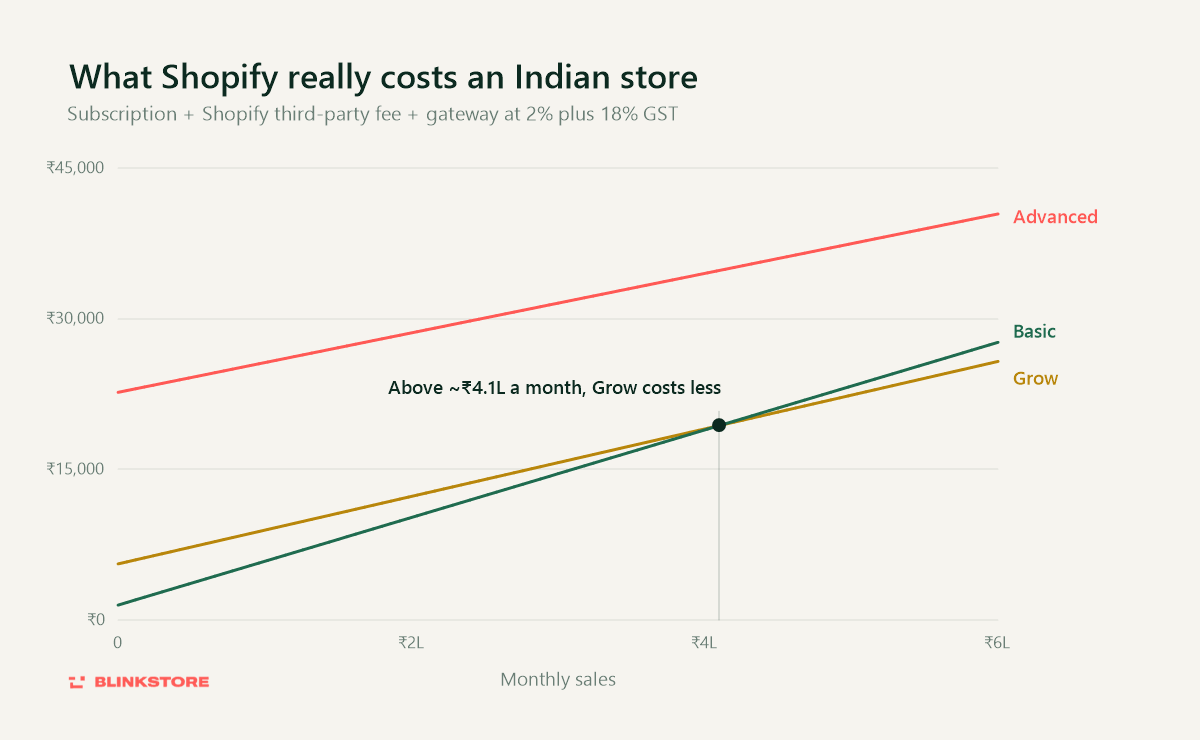
If you take one thing from this guide, take this: work out your own crossover point before you pick a plan. The formula is simply monthly fee plus (your monthly sales × total percentage fees), compared across tiers.
Marketplace fees changed in 2026, and it matters
Two changes this year have made marketplaces materially cheaper for Indian apparel and low-ticket sellers:
- Amazon India, from 16 March 2026, dropped the referral fee to zero on products priced under ₹1,000 across more than 1,800 categories, including apparel, and cut referral fees on higher-priced items. Watch the cliff: a ₹950 item pays no referral fee, a ₹1,001 item pays 15%.
- Flipkart, from 8 July 2026, removed the ₹1,000 price cap on zero commission for fashion, so eligible fashion sellers pay no commission at any price point.
Zero commission is not zero fees. Fixed fees per order, shipping, COD collection charges, return shipping and GST all still apply. But if you sell apparel under ₹1,000, the cost gap between a marketplace and your own store is narrower than it has been in years — which makes the “who owns the customer” question, rather than cost, the deciding one.
Ecommerce platform types compared
| Type | Examples | Typical cost | Best for | Main drawback |
|---|---|---|---|---|
| Marketplace | Amazon, Flipkart, Meesho | Per-order fees; commission cut sharply in 2026 | Getting sales quickly without an audience | You do not own the customer |
| Hosted store builder | Shopify, Wix, Squarespace, BigCommerce | Monthly fee plus 2–5% in combined fees | Brands that want control without servers | Transaction fees and lock-in |
| India-native builder | Dukaan, Zoho Commerce | Lower monthly cost, rupee pricing | Small Indian sellers, UPI and COD out of the box | Smaller app and theme ecosystem |
| Self-hosted / open source | WooCommerce, Magento | Software free; you pay hosting, plugins and maintenance | Teams with technical help who want full control | You own every breakage |
| Print-on-demand | Blinkstore and similar | No upfront cost; margin per unit | Testing designs without holding stock | Lower margin than bulk production |
If you want the full India-specific rundown of individual tools, we have a separate list of the best ecommerce platforms in India, and a broader guide to online selling platforms in India. This guide is about how to choose between them; those are about what is available.
Five mistakes that cost real money
- Comparing subscription prices only. The sticker price is often the smallest line. Compare total cost at your actual monthly revenue, fees included.
- Choosing for the business you want in three years. Pay for the volume you have now. Migrating later is annoying; overpaying for two years is worse.
- Assuming a store builder brings traffic. It does not. Budget for acquisition from day one, or start where the footfall already is.
- Ignoring COD and UPI. A checkout that handles Indian payment behaviour badly will quietly lose you conversions you never see.
- Not checking the exit. Confirm you can export products, customers and orders before you build a catalogue you cannot take with you.
How to choose in one hour
- Write down three numbers (10 min): current monthly sales, number of SKUs, and how much you can spend monthly on tools.
- Pick your route (10 min): marketplace if you need sales now, store builder if you are building a brand, print-on-demand if you are testing designs. It is fine to run two.
- Shortlist two platforms, never five (10 min): more options means no decision.
- Do the fee maths (15 min): monthly fee plus (monthly sales × total percentage fees) for each, at your current revenue and at double it.
- Test the checkout (10 min): start a free trial and place a real test order, including a COD order. Most platform frustrations show up here.
- Check the exit (5 min): find the export function before you commit.
Once the platform is chosen, the work moves to listings. Good product images matter more than theme choice — we cover the tools in the best AI photoshoot tools and the best mockup sites for clothing, and the marketing side in AI marketing tools.
Which platform suits which seller?
- You are starting with no audience and no budget: a marketplace, plus a simple store you build in parallel.
- You are building a clothing brand: a store builder, so you own the customer list from the first order. Start with how to start an online t-shirt business in India.
- You want to test designs before committing money: print-on-demand. See how to start a print on demand business and whether print on demand is profitable in India.
- You already do ₹4 lakh or more a month: redo the fee maths today. You are probably on the wrong plan.
- You have a developer: self-hosted is worth considering, provided someone genuinely owns maintenance.
There is no single best ecommerce platform, only the one that fits your revenue, your catalogue and where your traffic comes from. Pick the cheapest option that clears those three, and revisit it every six months.
Frequently asked questions
What is an ecommerce platform?
An ecommerce platform is the software that runs an online store — product catalogue, checkout, payments and order management. It covers hosted store builders like Shopify and Wix, self-hosted software like WooCommerce, and marketplaces like Amazon and Flipkart where you sell inside someone else’s storefront.
Which is the best ecommerce platform in India?
There is no single best one. For brand building with the least technical work, hosted store builders lead. For rupee pricing and native UPI and COD support, India-built platforms are often better value. For reach without an audience, marketplaces win. Choose by your monthly revenue, SKU count and where your traffic comes from.
What is the cheapest ecommerce platform in India?
Open-source software such as WooCommerce is free to install, so the cheapest route is self-hosting with basic hosting — but only if you can maintain it. Among hosted options, India-built platforms generally undercut global ones. Always compare total cost, since transaction fees frequently exceed the subscription.
How much does Shopify cost in India?
As of September 2026, Basic is ₹1,499/month, Grow ₹5,599, Advanced ₹22,680 and Plus from ₹1,75,000, after a 3-day trial and an introductory ₹20/month for three months. Because Shopify Payments is unavailable in India, add Shopify’s third-party transaction fee (2% on Basic) plus your gateway’s fee, roughly 2.36% with GST.
Which ecommerce platform is best for beginners?
For a complete beginner, a hosted store builder or a print-on-demand platform, because both remove hosting and maintenance entirely. Avoid self-hosted software as a first store unless you have technical help. Beginners should optimise for getting a first order quickly, not for maximum flexibility.
Should I sell on a marketplace or build my own store?
Marketplaces give you traffic but not customers; your own store gives you customers but not traffic. In 2026, with commission on apparel cut sharply on both Amazon India and Flipkart, cost is less decisive than it used to be. Many sellers run both: marketplace for volume, own store for margin and repeat buyers.
Do I need GST to sell online in India?
In most cases yes. Major marketplaces require a GSTIN to list taxable goods, and you will need GST-compliant invoicing regardless of platform. Register before you build your catalogue, since onboarding usually stalls without it. Check current thresholds with a tax professional for your category.
Can I change ecommerce platforms later?
Yes, but it costs time and usually some SEO. You can normally export products and customers, but themes, apps and URL structures rarely transfer cleanly. Check the export options before you commit, and keep your own backup of customer and order data from the start.
Read next
- Best ecommerce platforms in India
- 25 best print on demand sites in India
- Best Shopify apps for ecommerce stores
- What is dropshipping and how does it work in India
Pricing and fee details in this guide were checked in September 2026 on each provider’s own pricing pages, loaded from India: Shopify India plan prices and third-party transaction fees, Razorpay’s standard domestic rate and GST treatment, and the 2026 marketplace fee changes announced by Amazon India and Flipkart. Fees change often — confirm current rates before you commit.
