
To sell on Etsy from India you need a verified GSTIN, a Payoneer account and a one-time $10 set-up fee. Etsy reopened new Indian shops in June 2025 after pausing them since November 2023. The catch most guides miss: a new Indian shop can only sell internationally. Domestic sales to Indian buyers are not supported.
Almost every guide to selling on Etsy is written for an American seller. It tells you to open a shop, list a product and connect a bank account. An Indian seller who follows those steps hits a wall at the payment stage, because the rules for India are genuinely different and Etsy does not advertise them loudly.
This guide covers the Indian version: whether you can still open a shop, what Etsy requires before it lets you sell, exactly what the fees come to on a real order, what actually sells, and whether the whole thing is worth doing from here.
Table of Contents
Can you still sell on Etsy from India?
Yes. Etsy’s own seller documentation for India now states plainly that “sellers in India can now open new shops on Etsy”.
That sentence matters because it was not true for about a year and a half. Etsy paused onboarding of new Indian sellers around November 2023, and the pause ran until June 2025. During that period Indian sellers who already had shops could keep trading, but nobody new could join, and a petition asking Etsy to reopen India circulated in early 2025.
So if you read an article saying Indians cannot sell on Etsy, check its date. A lot of content written during the pause is still sitting on page one and is now wrong.
The restriction that is still in place
Reopening did not mean everything went back to normal. Two limits still apply to new Indian shops, and both are on Etsy’s own India help page:
- You can only sell internationally. Etsy states that Indian shops enrolled in Etsy Payments “cannot accept domestic sales at this time”. Your customers will be in the US, UK, Canada, Australia and Europe. Not in India.
- Digital items cannot be sold to Indian buyers either. Etsy’s wording is that digital listings “can be purchased by buyers in any region except India”.
Plan around this from day one. If your product idea only makes sense to an Indian buyer — regional-language slogans, India-specific festival merchandise aimed at the domestic market — Etsy is the wrong marketplace for it, and no amount of listing optimisation will fix that.
What you need before you open a shop
Four things. Get them ready first and the setup takes an afternoon. Miss one and you will stall halfway through onboarding.
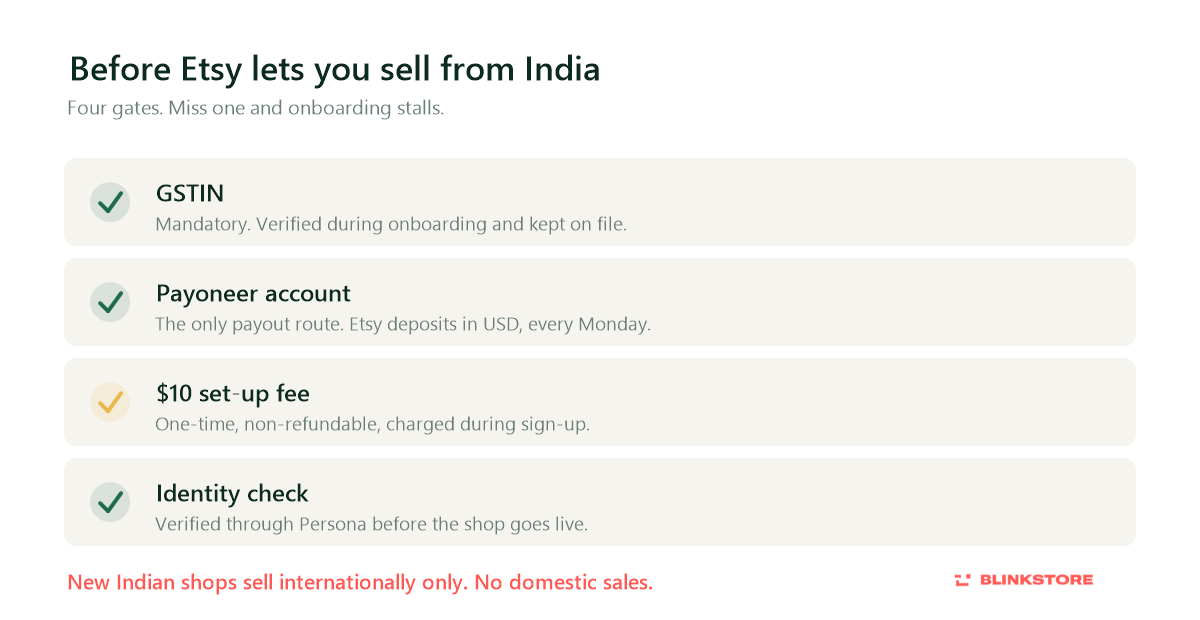
| Requirement | Detail |
|---|---|
| A valid GSTIN | Mandatory. Etsy requires new Indian sellers to verify a GSTIN during onboarding, and you must keep a valid and regular GSTIN on file to stay enrolled in Etsy Payments. |
| A Payoneer account | The only route to get paid. Etsy Payments for India runs through Payoneer, not a direct bank transfer. |
| $10 USD set-up fee | One-time and non-refundable, charged during the onboarding process itself. |
| Identity verification | Etsy verifies seller identity through Persona before the shop goes live. |
The GSTIN requirement is the one that stops most people, and it is the honest answer to a question a lot of beginners ask: no, you cannot sell on Etsy from India without GST registration. Etsy knows this is a hurdle — it has partnered with ClearTax to help sellers register.
How to start selling on Etsy in 7 steps
- Create your Etsy account at etsy.com/sell and complete identity verification.
- Set shop preferences — language, country and currency. Most Indian sellers list in USD because the buyers are overseas; listing in INR adds a currency conversion step for every buyer.
- Pick a shop name. Four to twenty characters, no spaces or special characters, and it cannot be changed casually later.
- Pay the $10 set-up fee when prompted during onboarding.
- Verify your GSTIN and connect Payoneer under Shop Manager → Finances → Payment settings.
- Create your first listings. Etsy gives you up to 20 photos per listing; the first one decides almost everything.
- Set delivery profiles. Your delivery settings decide which countries can buy from you, so get these right before you promote anything.
One practical note on step 6. Etsy’s guidance is that your first photo should be landscape or square, because Etsy crops the thumbnail differently for search, mobile and category pages. It also accepts PNG but does not support transparency — transparent areas render as solid black. Most design tools export a transparent PNG by default, which is how a perfectly good listing ends up as a black rectangle in the search grid. Flatten to JPG for anything going to Etsy.
Etsy fees for Indian sellers, on a real order
Etsy’s fees are individually small and collectively significant. Here they are, with the India-specific numbers where they differ.
| Fee | Amount | Notes |
|---|---|---|
| Set-up | $10 one-time | India-specific, non-refundable |
| Listing | $0.20 per listing | Charged whether or not it sells. Expires after 4 months, then auto-renews at $0.20 |
| Transaction | 6.5% of the order | Includes what you charge for postage and gift wrap |
| Payment processing (India) | 5% + ₹25 | Higher than most Western markets |
| Offsite Ads | 15% or 12% | Only on orders that came through an Etsy ad — see below |
What that adds up to
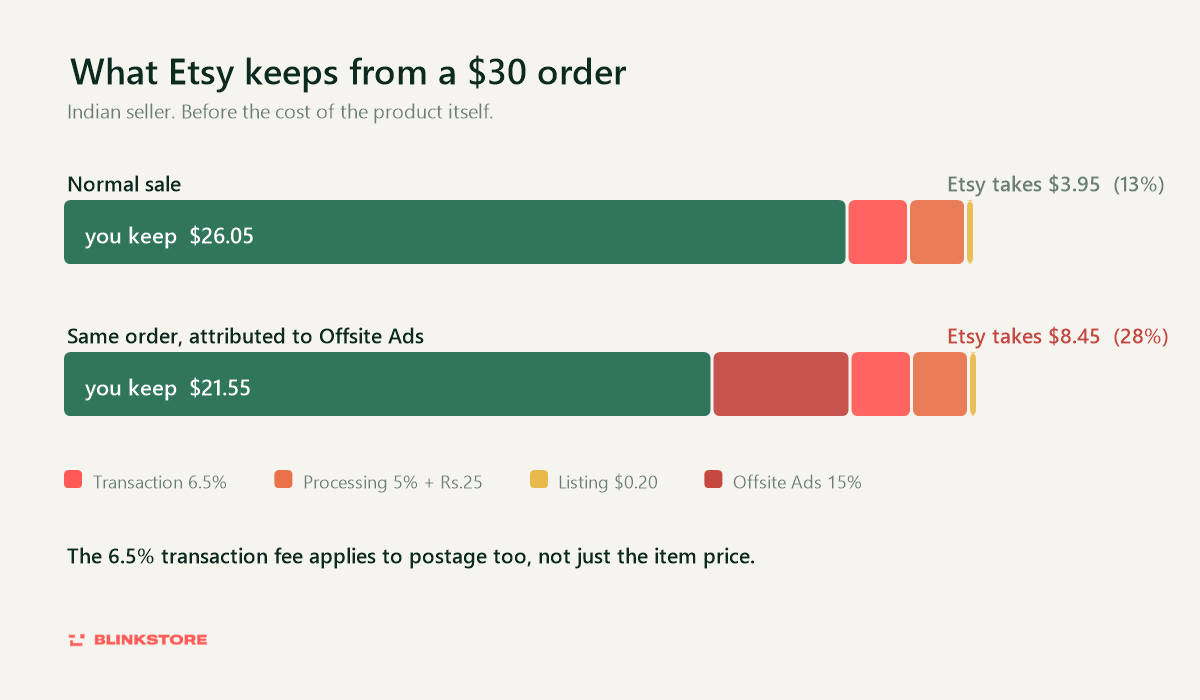
Take a t-shirt listed at $24 with $6 charged for postage. The buyer pays $30.
- Listing fee: $0.20
- Transaction fee, 6.5% of the full $30 including postage: $1.95
- Payment processing, 5% of $30 plus ₹25: roughly $1.80
That is about $3.95 on a $30 order, near enough 13%, before you have paid for the shirt itself or withdrawn the money. Build that into your price rather than discovering it in your payment account.
The Offsite Ads rule worth reading twice
Etsy enrols shops in Offsite Ads automatically and charges a fee when an order is attributed to one. The rate depends on your revenue over any rolling 365-day period:
- Under $10,000 in any consecutive 365 days — a 15% fee, and you are allowed to opt out.
- $10,000 or more in any consecutive 365 days — a discounted 12% fee, and you are required to participate for the lifetime of your shop. There is no opting out after that.
On that same $30 order, an Offsite Ads attribution adds $4.50 at the 15% rate. Total Etsy fees become about $8.45 — roughly 28% of the order. If you are running thin margins on a cheap product, one attributed sale can be a loss.
How you actually get paid
This is the part that surprises people, so it is worth being precise.
- Etsy deposits your funds in USD only, into your Payoneer account. It cannot deposit in another currency.
- Deposits run once a week, every Monday, at 11:30am ET — around 9pm in India.
- Payoneer handles the conversion when you withdraw, supporting USD, EUR, GBP and INR, and charges its own fee for that.
So there are two layers between a sale and rupees in your bank: Etsy’s fees, then Payoneer’s withdrawal and conversion fee. Weekly deposits also mean your cash cycle is slower than a domestic marketplace, which matters if you are paying a supplier per order.
What to sell on Etsy
Etsy is not a general marketplace. Everything listed must be handmade, vintage at least 20 years old, or a craft supply, and its core rule is that items must be “made, designed, handpicked or sourced by you”. Reselling mass-produced goods is not allowed.
Within that, the categories that consistently move are:
- Personalised gifts. Names, dates, custom portraits. Personalisation is the single strongest reason a buyer picks Etsy over Amazon.
- Digital downloads. Printable wall art, planners, templates, digital paper. No shipping, no unit cost, sold endlessly — just remember Indian buyers cannot purchase these from your shop.
- Apparel and accessories. T-shirts, hoodies, tote bags, caps.
- Home and decor. Posters, prints, candles, ceramics, textiles.
- Jewellery. Perennially one of Etsy’s largest categories, and one where Indian craftsmanship has a genuine edge.
- Craft supplies. Beads, fabric, findings — an underrated category with less design competition.
Indian sellers have a real structural advantage in a few of these. Jaipur and Surat give you gemstones and textiles at source; Tirupur gives you garments at wholesale; handloom and handicraft clusters across the country make products a buyer in Ohio genuinely cannot get locally. Lean into what is actually near you rather than competing with a US seller on generic designs.
How to sell shirts on Etsy without holding stock
Apparel is the most common starting point, and you do not need to buy inventory to do it. With print on demand you upload a design, the item is printed only after a customer orders, and the supplier ships it.
Two things to get right:
- Declare your production partner. Etsy allows print on demand, but if someone else manufactures your item you must list them as a production partner. Sellers get suspended for skipping this, not for using POD.
- Get the artwork to print resolution. A 12 by 16 inch print needs roughly 3600 by 4800 pixels at 300 DPI. Most design exports are well under that and print soft at the edges.
If you are choosing a supplier, we compared the domestic options in best print on demand sites in India, and print on demand profit margins covers what is left after fees. For listing images, t-shirt mockup generators compares the tools — and a design shown on an actual shirt converts far better than a flat artwork file.
Selling art on Etsy
Etsy is one of the better places to sell art online, because the audience arrives already expecting handmade and original work rather than the cheapest available option.
You have three routes, and they are not mutually exclusive. Sell originals, which carry the highest price and the highest shipping risk. Sell prints of your work through a print-on-demand partner, which removes both the stock and the shipping problem. Or sell digital downloads that the buyer prints themselves, which has the best margin and the most competition.
Most artists who do well run the first two together: a small number of originals for credibility and price anchoring, and prints for volume. If you are weighing up the channels, how to sell art online in India goes through the options, and print on demand sites for artists covers the platforms built specifically around artwork.
Is selling on Etsy worth it from India?
It depends almost entirely on what you sell and what it costs you to make.
It works when your product is genuinely differentiated, your margin can absorb roughly 13% in fees plus international shipping, and you are selling something a Western buyer wants and cannot easily source at home. Handmade jewellery, textiles, personalised gifts and original art all fit.
It does not work when you are selling a generic low-priced item. On a $12 product, fees plus shipping eat the entire margin before you have accounted for your time. It also does not work if your target customer is Indian, because new Indian shops cannot sell domestically at all.
The honest summary: Etsy is a good fit for a small number of Indian sellers with genuinely distinctive products and enough price headroom, and a poor fit for everyone hoping it is an easy side income. The $10 set-up fee is trivial; the GST registration and the international-only restriction are what should decide it for you.
A realistic first month
- Sort the GSTIN first. Everything else is blocked behind it.
- Open the shop and pay the $10. Connect Payoneer before you list anything.
- List ten products, not one. Ten listings cost $2 and give Etsy’s search something to work with.
- Price for fees and international postage from the very first listing.
- Order one sample yourself so you know what your buyer actually receives.
- Decide on Offsite Ads deliberately while you still have the option to opt out.
- Read visits against impressions in Shop Manager after three weeks. That ratio tells you whether your first images are working.
If you want to test the product side before committing to GST registration and international shipping, print on demand on your own store is the lower-friction start — no set-up fee, no listing fee per product, and you can sell to Indian buyers. Create your store free and see whether the designs sell before you take on Etsy’s requirements.
Etsy from India is a real opportunity with real paperwork attached. Go in knowing the fees and the restrictions and it is a business. Go in expecting a quick side hustle and the GSTIN form alone will stop you.
FAQs about selling on Etsy from India
Can Indians sell on Etsy now?
Yes. Etsy reopened new seller onboarding for India in June 2025, after pausing it since around November 2023. New Indian shops can sell internationally only, and must verify a GSTIN and use Payoneer to receive payments.
How much does Etsy take from a $100 sale?
About $12, or roughly 12%, for an Indian seller. That is a 6.5% transaction fee ($6.50), a 5% + ₹25 payment processing fee (about $5.30) and the $0.20 listing fee. If the order came through Offsite Ads, add 15% and the total rises to around $27.
Can I sell on Etsy from India without GST?
No. A valid GSTIN is mandatory for new Indian sellers. Etsy requires you to verify it during onboarding and to keep a valid, regular GSTIN on file to stay enrolled in Etsy Payments. Etsy has partnered with ClearTax to help sellers register.
Can I sell to customers in India on Etsy?
No. Etsy states that Indian shops enrolled in Etsy Payments cannot accept domestic sales at this time, and digital listings can be bought by buyers in any region except India. Your customers will be outside India.
How can a beginner start selling on Etsy?
Register a GSTIN, create an account at etsy.com/sell, complete identity verification, pay the one-time $10 set-up fee, connect a Payoneer account, then create listings. Set your delivery profiles before promoting anything, because they decide which countries can buy from you.
What is the downside of selling on Etsy?
Fees and competition. Etsy takes roughly 12 to 13% of an order before your product cost, rising to nearly 28% on an Offsite Ads sale. Once your shop passes $10,000 in any 365-day period, Offsite Ads become mandatory for the lifetime of the shop and cannot be switched off.
How do Indian sellers get paid on Etsy?
Through Payoneer, in USD only. Etsy deposits funds to your Payoneer account once a week, every Monday at 11:30am ET, which is about 9pm India time. Payoneer then converts to INR when you withdraw and charges its own fee for that.
Can I sell print on demand products on Etsy?
Yes, provided you designed the item and you declare your production partner on the listing. Etsy allows print on demand under its rule that items must be made, designed, handpicked or sourced by you. Sellers get suspended for hiding a production partner, not for using one.
