
Churn prediction software uses your customer data to flag who is about to stop buying, so you can act before they go. For ecommerce brands, Klaviyo’s built-in predictions are the cheapest useful start. Baremetrics and Churnkey handle subscription churn. Most of the rest are built for SaaS — and four of the eight below will not quote a price without a sales call.
Almost every guide to this category is written for SaaS companies with recurring revenue and a customer success team. If you run an online store, that advice does not transfer cleanly. Your churn is not a cancelled subscription; it is a customer who quietly never comes back.
This guide covers both, is honest about which tools suit which business, and starts with the question the vendor blogs skip.
First: do you actually need churn prediction software?
Probably not yet, and here is the arithmetic.
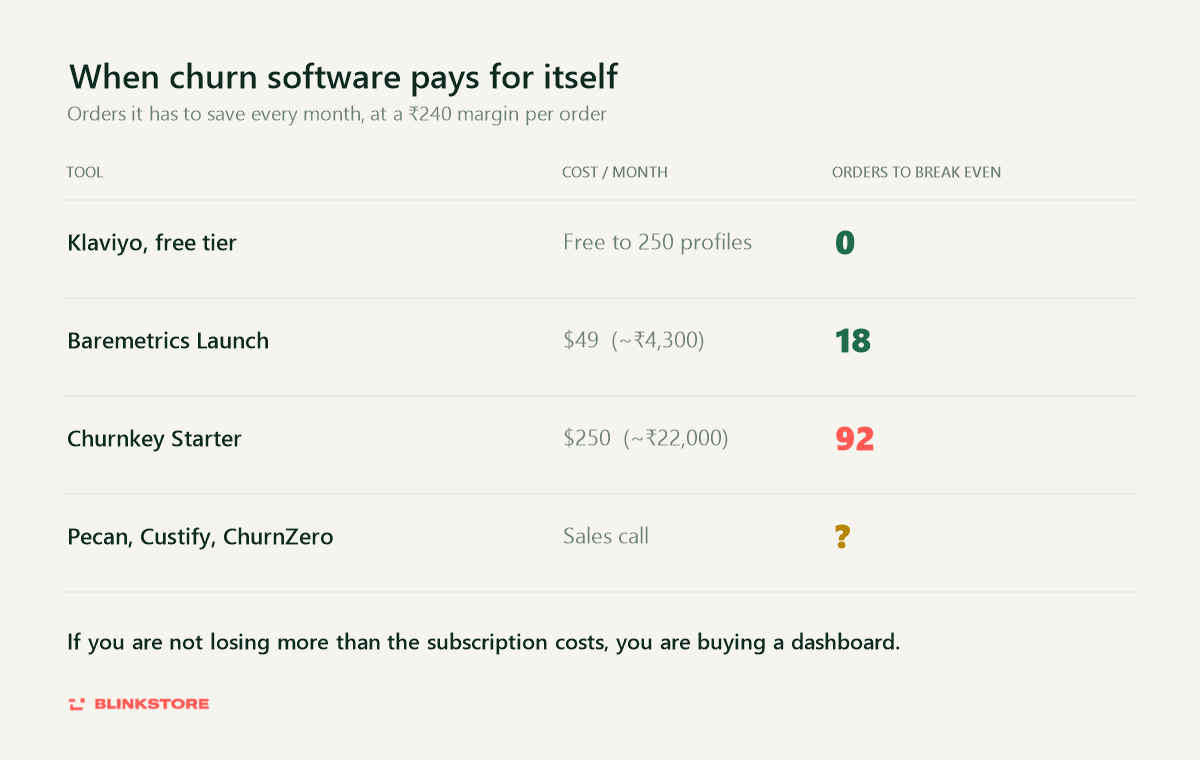
These tools are priced for businesses losing real money to churn. Churnkey starts at $250 a month, roughly ₹22,000. If your average order earns you ₹240 in margin, that tool has to save you 92 orders every single month before it has paid for itself. Baremetrics’ cheapest plan needs to save 18.
There is also a data floor. Klaviyo will not generate predictions at all until your account has 500+ customers, 180 days of order history and an average of three or more orders per customer. Below that, there is not enough signal for a model to learn from, and no tool can invent it.
So the honest test is two questions. Do you have enough history for a prediction to mean anything? And are you losing more each month than the subscription costs? If either answer is no, skip the whole category and read the last section instead.
What churn prediction software actually does
Underneath the marketing, these tools do three different jobs and the difference matters:
- Prediction. Scores each customer on how likely they are to stop buying, usually from order frequency, recency and engagement. Klaviyo and Pecan AI sit here.
- Customer success workflow. Health scores, alerts and playbooks so a human intervenes before renewal. Gainsight, ChurnZero, Custify and Totango sit here. These assume you have named accounts and a CS team.
- Churn recovery. Catching people at the moment of cancelling or when a payment fails. Churnkey and Baremetrics’ add-ons sit here, and for most businesses this is where the fastest money is.
Buying a prediction tool when your real problem is failed payments is the most common and most expensive mistake in this category.
The 8 best churn prediction software tools
1. Klaviyo — best for ecommerce and D2C brands
If you sell physical products, start here, because you may already be paying for it. Klaviyo’s predictive analytics produce a churn risk score, a predicted customer lifetime value and an expected date of next order for each customer, then let you build segments and flows from them directly.
The churn risk score falls after every purchase and climbs with inactivity, so you can trigger a win-back email before someone drifts. Models retrain weekly.
What it costs: there is a genuinely free plan, limited to 250 active profiles and 500 email sends a month. Paid pricing scales with your profile count and sits behind a calculator rather than a published table.
The catch: predictions need 500+ customers and 180 days of history, and the free plan caps you at 250 profiles — so the free tier can never unlock them. Per customer, churn risk needs at least one order in the last 30 days, and the next-order date needs at least two past orders.
2. Baremetrics — best subscription metrics at a published price
Baremetrics reads your billing system and turns it into churn, MRR, LTV and retention dashboards without you building anything. It is one of the few tools here that tells you the price up front.
What it costs: Launch is $75/month, or $49 billed annually, for businesses up to $360K ARR with one integration. Growth is $255/$189 for $360K–$3.6M ARR and two integrations. Scale is $1,152/$749 for $3.6M+ with unlimited integrations. There is a free trial.
Worth knowing: the churn-fighting features are paid add-ons, not included — Payment Recovery is +$129/month and Cancellation Insights is +$129/month. It connects to Stripe, Braintree, Chargebee, Recurly, Shopify, the App Store, Google Play, QuickBooks and Xero, which is why it works for subscription ecommerce as well as SaaS.
3. Churnkey — best for stopping cancellations in the moment
Churnkey is not really a prediction tool. It intervenes at the two moments churn actually happens: when someone clicks cancel, and when a payment fails. Cancel flows offer a pause or a discount based on the stated reason; payment recovery retries intelligently rather than on a fixed schedule.
What it costs: Starter is $250/month billed yearly ($300 monthly) for under $5k monthly churn volume. Core runs $500–$1,300 yearly ($600–$1,560 monthly) and scales with churn volume. Intelligence is $625–$1,425 and adds AI-generated offers. Enterprise is custom above $100k monthly churn. Starter and Core have a 14-day free trial with no card.
The catch: the entry price assumes you already have meaningful churn to recover. Below roughly $5k a month in churn, the maths does not work.
4. Pecan AI — best if you want real predictive models without data scientists
Pecan builds actual machine learning models on your raw data, with an AI agent handling data preparation and modelling. It covers churn and lifetime value alongside demand forecasting and campaign ROAS, and unlike most of this list it explicitly serves ecommerce as well as SaaS.
What it costs: not published. The tiers are Starter (2 prediction batches a month, 500M rows of storage), Team (10 batches, 2Bn rows) and Business (custom, 5Bn rows). Prices come from sales, and no free trial is advertised.
5. Custify — customer success for SaaS teams
Custify handles health scores, custom alerts into Slack or email, automated playbooks and a Customer 360 view. It is competent at what it does, and what it does is help a customer success team manage named B2B accounts.
What it costs: not published. The site routes you to a demo request, and no free trial is advertised.
Be clear about fit: the product is built around product adoption, usage and renewals. There is no ecommerce-specific functionality. If you sell t-shirts, this is not your tool.
6. ChurnZero — customer success automation at scale
ChurnZero is one of the established names in customer success, built around health scoring, in-app communication and automated plays that fire when an account’s usage drops.
What it costs: there is no pricing page at all — the URL returns a 404. Everything goes through sales.
7. Gainsight — the enterprise option
Gainsight is the heavyweight of customer success software, spanning CS, product experience and customer education. If you have a CS org with headcount and a renewals forecast, it is a serious platform.
What it costs: not published. The plans are named Essentials and Enterprise, and the page asks you to request pricing. A free trial exists for the Product Experience product only.
Be clear about fit: this is enterprise software. For anyone reading this who runs a store, it is the wrong end of the market entirely.
8. Amazon SageMaker — best if you want to build it yourself
SageMaker is not a churn product; it is the infrastructure to build one. If you have your order history in a warehouse and someone who can write Python, a churn model is a well-understood problem and you will pay only for the compute you use.
What it costs: pay per use, so it can be very cheap to start and unpredictable at scale.
The honest trade-off: you are buying flexibility with engineering time. For most teams that time is worth more than the subscription you avoided.
Which of these will tell you the price?
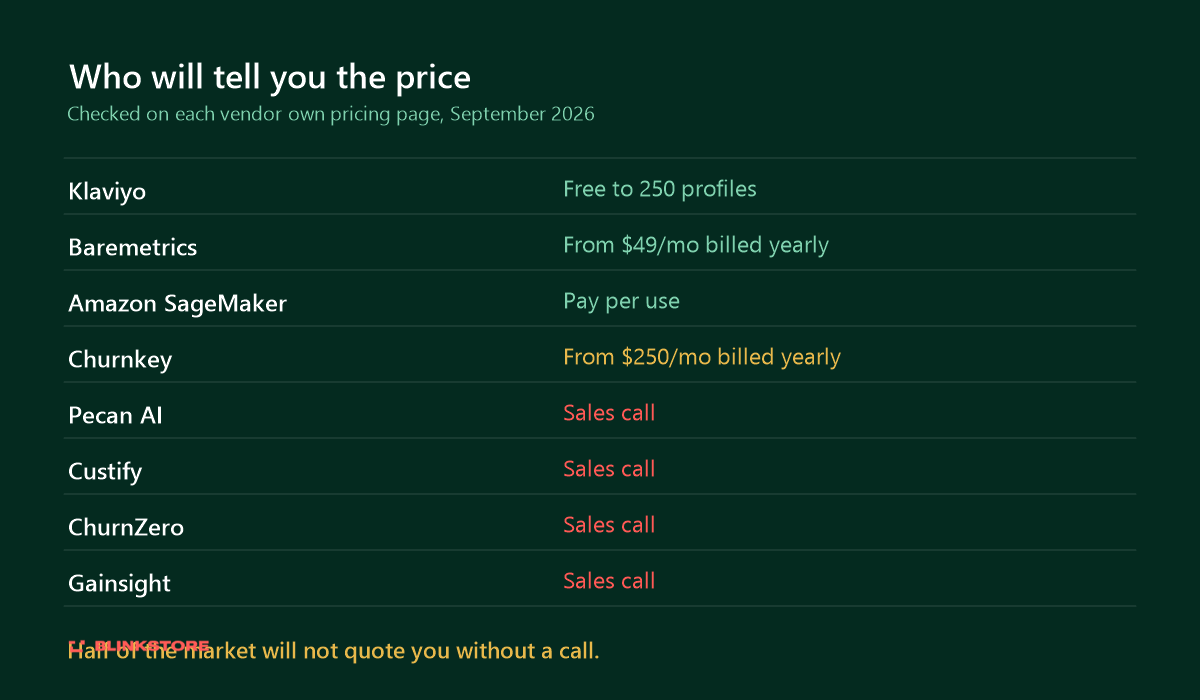
This is worth its own section, because it tells you who each tool is really sold to. Tools that publish prices are built for self-serve customers. Tools that hide them are built for deals with a procurement process.
Of the eight above, four publish nothing: Pecan AI, Custify, ChurnZero and Gainsight. If you are a small brand, that is a useful filter on its own.
Comparison
| Tool | Best for | Price from | Free option |
|---|---|---|---|
| Klaviyo | Ecommerce and D2C | Scales with profiles | Free to 250 profiles |
| Baremetrics | Subscription metrics | $49/mo billed yearly | Free trial |
| Churnkey | Cancel flows and failed payments | $250/mo billed yearly | 14-day trial |
| Pecan AI | Custom ML predictions | Sales call | Not advertised |
| Custify | SaaS customer success | Sales call | Not advertised |
| ChurnZero | CS automation | Sales call | Not advertised |
| Gainsight | Enterprise CS | Sales call | Product Experience only |
| Amazon SageMaker | Building your own | Pay per use | AWS free tier |
The churn most lists ignore
There are two kinds of churn and they need completely different fixes.
Voluntary churn is a customer deciding to leave. That is what prediction models are for, and it is the harder one to fix, because by the time the score moves the decision is often made.
Involuntary churn is a customer who wanted to stay but whose card expired or whose payment failed. No prediction required. It is a plumbing problem with a plumbing fix: retry logic, card updater, a dunning email sequence that does not sound like a debt collector.
If you have never separated these two numbers, do that before you buy anything. It is common for involuntary churn to be a large share of the total, and it is far cheaper to fix.
What to do if you are too small for any of this
Most stores reading this are below the threshold, and that is fine. You can do the useful 80% with what you already have:
- Measure repeat purchase rate. What share of customers bought a second time in 90 days? One number, tracked monthly, beats any dashboard you are not going to read.
- Define churn for your business. If your product is reordered every 6 weeks, a customer silent for 12 weeks has churned. Write the number down so it stops being a feeling.
- Fix failed payments first. If you sell subscriptions, check what happens today when a card declines. Usually the answer is nothing.
- Email the quiet ones. Segment customers who have not ordered in your churn window and send them something useful. This is free on most email platforms and outperforms most prediction models at small scale.
- Ask the ones who left. Five honest replies will teach you more than a model trained on 300 orders.
For the platform side of this, see our guides to the best ecommerce platforms in India and the best Shopify apps for ecommerce stores, where most of the retention tooling actually lives. If margins are what is really worrying you, is print on demand profitable in India works through the numbers.
How to choose
- You sell physical products: Klaviyo, using the predictions inside the email platform you already run.
- You sell subscriptions and want the numbers: Baremetrics.
- Your problem is cancellations and failed payments: Churnkey.
- You have clean data and want a real model: Pecan AI, or SageMaker if you have the engineers.
- You have a customer success team and named accounts: Custify, ChurnZero or Gainsight, in ascending order of size.
- You are under 500 customers: none of them. Go back to the previous section.
Frequently asked questions
What is churn prediction software?
Churn prediction software analyses customer behaviour — order frequency, recency, engagement, product usage — to estimate how likely each customer is to stop buying. The output is usually a risk score you can build segments, alerts or automated campaigns from, so you can intervene before the customer leaves rather than after.
How accurate is churn prediction?
It depends entirely on how much history you feed it. Models need hundreds of customers and months of orders before their scores mean anything. Even then, a score is a probability, not a verdict. Treat it as a prioritised list of who to contact, not a prediction of individual behaviour.
How much does churn prediction software cost?
Published prices range from free to around $750 a month. Baremetrics starts at $49/month billed yearly, Churnkey at $250/month billed yearly, and Klaviyo has a free tier limited to 250 profiles. Four of the eight tools in this guide — Pecan AI, Custify, ChurnZero and Gainsight — do not publish pricing at all.
Is there free churn prediction software?
Klaviyo’s free plan is the closest thing, though its 250-profile cap means you will not reach the 500-customer threshold its predictions require. Amazon SageMaker has an AWS free tier if you are building your own model. Several tools offer 14-day trials, but no serious churn platform is free at working scale.
What is a good churn rate?
There is no universal number, because it depends on your model and purchase cycle. What matters more is the direction of travel and the split between voluntary and involuntary churn. A business whose churn is mostly failed payments has a very different problem, and a much cheaper fix, than one losing customers by choice.
What is the difference between voluntary and involuntary churn?
Voluntary churn is a customer choosing to stop. Involuntary churn is a customer who intended to stay but whose payment failed — expired card, insufficient funds, a bank decline. Involuntary churn needs retry logic and dunning emails, not a prediction model, and it is usually the faster money to recover.
Can churn prediction work for a small store?
Below roughly 500 customers and six months of history, no model has enough signal to be useful. At that size you get more from tracking repeat purchase rate, defining a churn window for your product, and emailing customers who have gone quiet. Those cost nothing and work immediately.
Do I need churn prediction if I sell one-off products?
Not prediction, but retention still applies. For one-off purchases the equivalent question is repeat purchase rate: what share of buyers come back at all. Most of the value comes from a good post-purchase email sequence and a reason to return, not from scoring customers.
Read next
- Best ecommerce platforms in India
- Online selling platforms in India
- 40+ best AI marketing tools
- Best trending ecommerce products to sell
- How to start a print on demand business
Prices and plan limits were checked on each vendor’s own pricing page in September 2026. Rupee figures are approximate conversions for scale, not quotes. Four of the tools covered do not publish pricing; where that is the case it is stated rather than estimated.
