
AI fashion trends in 2026 come down to five practical shifts: AI trend research became usable by small brands, AI product photography replaced the studio shoot, micro-trends accelerated, shoppers began discovering products through AI assistants, and India introduced labelling rules for AI-generated content. Most of the rest is vendor marketing.
If you have read three articles on this topic, you have probably read the same article three times. Reactive smart textiles. Multimodal agents. Hyper-personalisation at scale. All of it written by companies selling AI software, none of it written for someone who prints 60 t-shirts a month and needs to decide what to put on them.
This is the version for that person. What changed, what it costs you, what you have to do differently, and what you can safely ignore.
What the trend lists get wrong
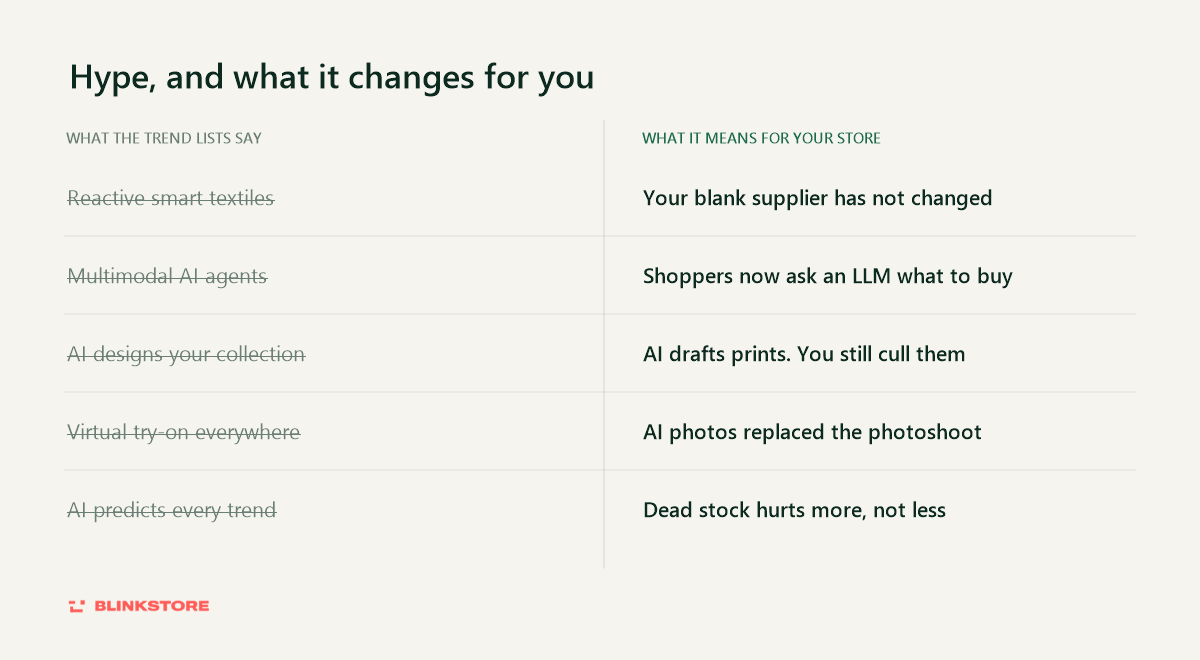
Most AI fashion trend roundups describe what large brands with data teams are piloting. That is a different business from yours. A trend only matters to a small brand if it changes a decision you make this month — what to design, what to photograph, what to stock, what to write on a listing.
Held to that test, most of the list collapses.
What the industry data actually says
The most useful number comes from the annual State of Fashion report by McKinsey and The Business of Fashion: 35% of fashion executives say they are already using generative AI for business functions such as customer service, image creation, copywriting and product discovery. Notably, those are the unglamorous applications — not design, not forecasting.
The second number is the one that should calm you down. Up to 90% of AI initiatives never scale past the pilot stage, usually because the underlying data is not good enough to support them. Large brands are not quietly winning at this while you fall behind. Most of them are stuck too.
The report also flags something that matters much more to a small seller than to a big one: customers are increasingly using large language models to search for products, compare options and get recommendations. That is a genuine change in how people find things to buy, and it is one of the few trends here you can act on immediately.
The 5 AI fashion trends that actually affect a small brand
1. Trend research stopped being a subscription you cannot afford
Professional trend forecasting used to mean a five-figure annual subscription to a forecasting agency. The practical change is not that AI now predicts fashion — it is that the raw signals those agencies read are now free and searchable, and an AI assistant can summarise them for you in an afternoon.
A workable free stack: Google Trends for search demand and regional breakdowns, Pinterest Trends for visual and seasonal search behaviour, and the Meta Ad Library to see which creatives competitors are actually spending money on. Feed what you find to an AI assistant and ask it to find the pattern, not the answer.
One caution worth more than the whole method: a rising search trend tells you attention exists, not that anyone will pay. Check whether people are buying, not just looking. Our roundup of trending ecommerce products is a useful sense-check on what actually sells.
2. The product photoshoot became optional
This is the single biggest practical change for anyone selling clothing online, and it is the one with the clearest return.
Generating a studio-quality product image from one plain photo now costs a few hundred rupees a month, against tens of thousands for a half-day shoot with a model and a studio. For print-on-demand, where you may not hold stock at all, it removes the last hard blocker to listing a product. We compared the options in detail in the best AI photoshoot tools, and the mockup side is covered in the best mockup sites for clothing.
The catch: a generated image will happily relight your garment into a colour you do not sell. Match to your supplier’s swatch, not your screen. A mockup that flatters a product you cannot ship buys you returns, and returns cost more than photography ever did.
3. Micro-trends got faster, and that is a risk before it is an opportunity
AI-assisted design and faster production mean a trend can appear, saturate and die inside a few weeks. The trend lists frame this as an opportunity to move quickly. For a small brand it is mostly an inventory risk.
If you hold stock, a micro-trend you catch late becomes dead stock you discount to zero. This is the strongest practical argument for print-on-demand over bulk ordering right now: you can test a trend design at a unit cost of one, and if it fails you have lost a listing, not a carton. The maths is worked through in is print on demand profitable in India.
4. Customers started finding products through AI assistants
People now ask an AI assistant “what should I get my brother who likes cricket and bad puns” and act on the answer. Those assistants read the same web pages search engines do, but they reward different things: clear product descriptions, specific details, honest comparisons and real answers to real questions.
Practically, that means your listings and blog content should state plainly what a product is, who it suits, what it is made of and how it fits. Vague lifestyle copy performs badly with an assistant that is trying to match a specific request. A published t-shirt size chart is a small example of exactly the kind of concrete, extractable detail that gets a product surfaced and cuts returns at the same time.
5. AI-generated design became a legal question, not just a creative one
This is the trend the vendor blogs skip, and it is the one most likely to cost you money. In India, two separate things changed: how AI content must be labelled, and who owns an AI-generated design. Both are covered below.
Three checks before you sell an AI-generated design in India
Check 1: label it
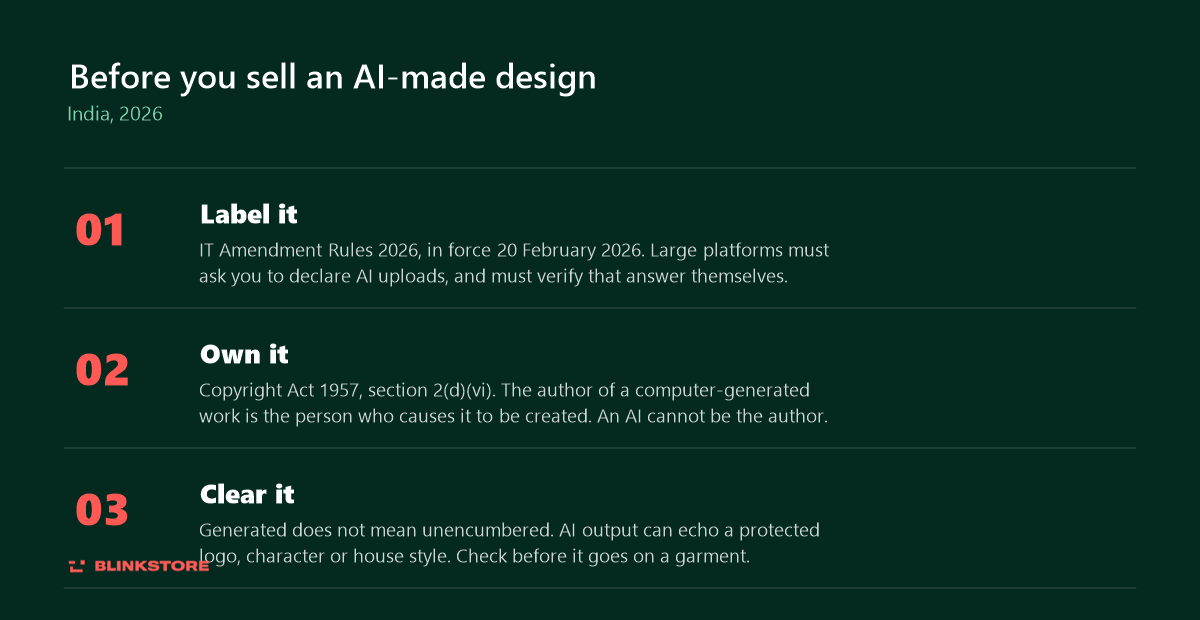
On 10 February 2026, India’s Ministry of Electronics and Information Technology notified amendments to the IT Rules that brought synthetically generated information — AI-generated text, images, audio and video — into platforms’ due-diligence obligations. They came into force on 20 February 2026.
The labelling duty sits with the platforms, not with you directly. But the practical effect reaches you: significant social media intermediaries (broadly, platforms with more than five million Indian users) must require users to declare whether what they upload is synthetically generated, and they cannot simply take your word for it — they must deploy technical measures to verify those declarations.
So if you run AI-generated model shots or AI video in your ads, expect to be asked, and answer honestly. One detail worth knowing: the draft rules published in October 2025 proposed that visible labels cover 10% of the display area. That requirement did not make it into the final version.
Check 2: own it
Under section 2(d)(vi) of the Copyright Act, 1957, the author of a computer-generated literary, dramatic, musical or artistic work is “the person who causes the work to be created”. India’s Copyright Office has been consistent that an AI system cannot itself be an author — a registration naming an AI as sole author was refused, while a later application naming a human alongside the AI was accepted.
The office put the principle well: autonomy in execution is not the same as conception of a work. In plain terms, the more your own creative direction, editing and selection shaped the design, the stronger your claim. A one-line prompt with the first output taken as-is is the weakest position you can be in.
Keep your prompts, iterations and edits. If ownership is ever questioned, that record is your evidence of human authorship.
Check 3: clear it
Generated does not mean unencumbered. An AI model can reproduce a protected logo, a recognisable character or a studio’s house style closely enough to attract a takedown or a legal letter — and the liability lands on whoever sells the garment, not on the tool.
Before a design goes to print: reverse image search it, check for any text or marks the model has hallucinated into the artwork, and avoid anything that references a brand, film, team or musician you do not have rights to. This is the most common way small print-on-demand stores get suspended, and it was true before AI. AI just made it faster to do accidentally.
This is general information for sellers, not legal advice. If a design is central to your business, get a professional opinion.
A realistic AI workflow for a small clothing brand
Ignoring everything above, here is what a week actually looks like if you use AI sensibly:
- Research (60 minutes). Pull search and visual trend data, check what competitors are advertising, and ask an assistant to summarise the overlap. Write down three specific design directions, not twenty.
- Draft (2 hours). Generate print concepts. Expect to reject most of them. The value of AI here is volume of options, not quality of any one option.
- Cull and fix (2 hours). This is the part that is still entirely yours. Fix the linework, correct the text AI mangles, adjust colours to what your supplier can actually print.
- Clear it (20 minutes). Run the three checks above.
- Mock up and shoot (1 hour). Generate mockups and product images per colour variant.
- List (1 hour). Write plain, specific descriptions with materials, fit and sizing. Publish.
- Test small. Put a modest ad budget behind two designs, not six. Kill what does not move within a week.
If you are still setting up, start with how to start a print on demand business and how to start an online t-shirt business in India.
What AI still cannot do
- It cannot tell you what your customers want. It can only tell you what has been popular. Those are not the same thing, and the gap is where new brands are built.
- It cannot fix a bad blank. No amount of generated imagery survives a shirt that shrinks two sizes after one wash.
- It cannot carry taste. AI output converges on an average. A brand that looks like the average of everything on the internet is not a brand.
- It cannot own your risk. Licensing, disclosure and quality are yours. The tool has no liability.
- It cannot replace one real photo. Order a sample, shoot it once, lead with it. Use AI for the rest of the set.
So what should you actually do?
Pick two things from this article and ignore the rest. For most small brands the highest-return pair is: use AI for product imagery, because the cost saving is immediate and measurable, and write listings that answer specific questions, because that is what both search engines and AI assistants now reward.
Everything else — smart textiles, agentic shopping, AI-run supply chains — is real, but it is not your problem this quarter. When it becomes your problem, it will be obvious.
Frequently asked questions
What are AI fashion trends?
AI fashion trends are the ways artificial intelligence is changing how clothing is designed, produced, photographed and sold. In 2026 the practical ones are AI-assisted trend research, AI product photography, faster micro-trend cycles, product discovery through AI assistants, and new rules on labelling and owning AI-generated designs.
Can AI predict fashion trends accurately?
AI is good at spotting patterns in existing data — search volume, social engagement, sales history, weather. It is genuinely useful for confirming a trend is growing. It is much weaker at predicting something new, because it can only extrapolate from what already exists. Treat it as evidence, not as a forecast.
Can I sell t-shirts with AI-generated designs in India?
Yes. Nothing in Indian law prevents selling a garment carrying an AI-generated design. Three things matter: your design must not infringe someone else’s copyright or trademark, you should keep evidence of your own creative input so you can claim authorship, and if you upload AI-generated media to large platforms you may be asked to declare it.
Who owns an AI-generated design in India?
Under section 2(d)(vi) of the Copyright Act, 1957, the author of a computer-generated work is the person who causes the work to be created. India’s Copyright Office has refused to register an AI system as sole author but has accepted registration where a human is named. The more direction and editing you contributed, the stronger your position.
Do I have to label AI-generated images in my ads in India?
The formal obligation under the IT Amendment Rules, in force since 20 February 2026, sits with platforms rather than individual sellers. In practice, large platforms must ask you to declare whether uploaded content is synthetically generated and must verify that declaration, so you should answer accurately. Labelling AI visuals honestly is also simply good practice with buyers.
Will AI replace fashion designers?
Not on current evidence. Industry data shows most generative AI use in fashion is in customer service, image creation and copywriting rather than design, and around 90% of AI initiatives fail to scale beyond pilots. AI produces options quickly; deciding which option is any good remains a human job.
What is the cheapest way for a small brand to use AI?
Product imagery. A paid AI photo tool costs a few hundred rupees a month against tens of thousands for a conventional shoot, and the output goes straight onto listings and ads. Start there before spending anything on AI design or forecasting tools.
Is print-on-demand better than bulk ordering for chasing trends?
For trend-led designs, usually yes. Micro-trends now move fast enough that bulk stock ordered late becomes dead stock. Print-on-demand lets you test a design at a unit cost of one, so a failed trend costs you a listing rather than a carton of unsold shirts.
Read next
- Best AI photoshoot tools in 2026
- 25 best print on demand sites in India
- 40+ best AI marketing tools for marketers
- Top clothing brands in India
- Online selling platforms in India
Sources checked in September 2026: the State of Fashion 2026 report by McKinsey and The Business of Fashion; the Information Technology (Intermediary Guidelines and Digital Media Ethics Code) Amendment Rules, 2026, notified by MeitY on 10 February 2026; and section 2(d)(vi) of the Copyright Act, 1957 together with published decisions of the Indian Copyright Office.
