
Yes, you can sell AI art in India, and you can own the copyright in it — but only if you are named as the author, not the AI. In September 2026 India’s Copyright Office ruled that an AI system cannot be an author under the Copyright Act. The commercial side is simpler: print on demand, digital downloads and stock libraries all accept AI work, with disclosure.
Almost every guide on selling AI art is written for American sellers. They cite US Copyright Office refusals, quote prices in dollars, and point you at Etsy and Redbubble. India’s legal position is genuinely different from America’s, the payment and GST realities are different, and shipping a poster from a US printer to a buyer in Pune makes no commercial sense.
This guide covers the Indian position: what the law actually says after the September 2026 order, what your AI tool’s licence permits, where to sell, how to prepare files that survive printing, and what the money looks like.
Is it legal to sell AI art in India?
Selling it is legal. Owning the copyright depends on how you file, and that is where India differs from the United States.
What India’s Copyright Office decided in September 2026
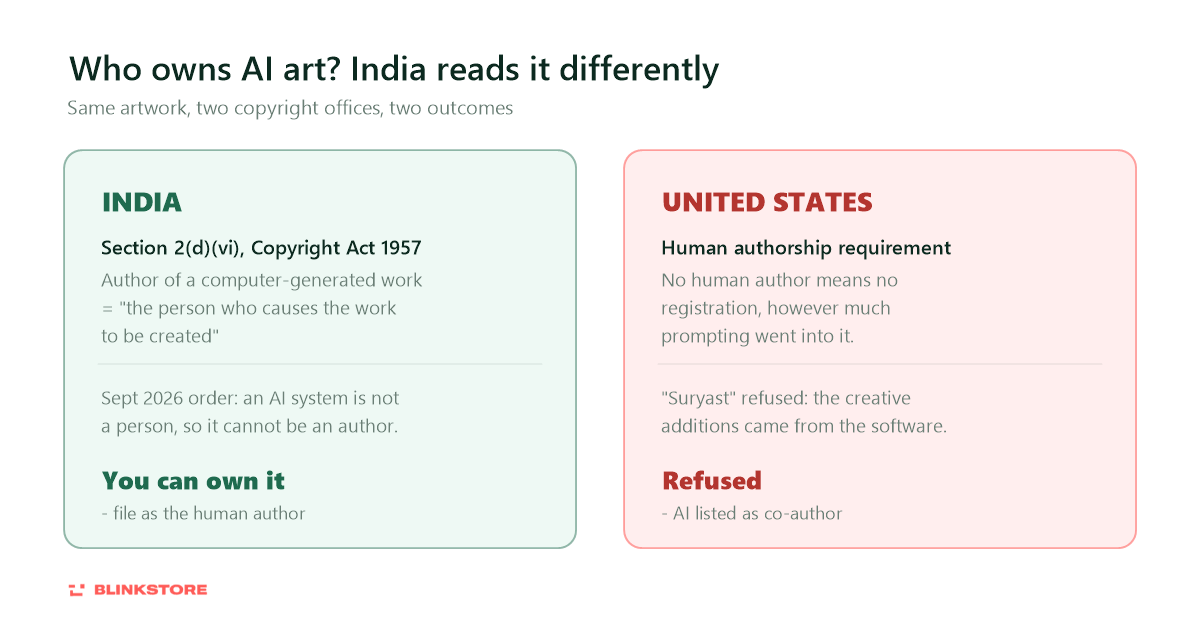
At the start of September 2026 the Indian Copyright Office issued an order on an application that named an AI system as an author. The order held that an AI system is not a natural or juristic person recognised in law, and therefore cannot be recognised as an author under Section 2(d)(vi) of the Copyright Act, 1957.
The detail that matters for sellers is what the order did not say. It did not say the artwork was unoriginal, and it did not say AI-assisted work is unprotectable. It drew a line between the tool and the person: the AI may produce the image, but the law looks for the human who caused the work to come into existence.
Section 2(d)(vi): why India reads differently from the US
India’s Copyright Act has a clause most countries do not. Section 2(d)(vi) defines the author of a computer-generated work as “the person who causes the work to be created”.
That wording is unusually helpful if you are the one writing the prompts. The US Copyright Office has repeatedly refused registration for AI-generated images on the ground that there is no human author — it rejected Ankit Sahni’s artwork Suryast, made with his own photograph and an AI tool called RAGHAV, on the basis that the creative additions came from the software rather than from him. India’s Copyright Office had registered the same work in November 2020, listing RAGHAV as a co-author, and then issued a withdrawal notice. That contradiction was never conclusively resolved, which is precisely what the September 2026 order was cleaning up.
What this means for you in practice
- Never list the AI as an author or co-author. That is the single thing guaranteed to get your application refused. File as the sole human author.
- Keep evidence of your creative input. Save prompts, iterations, the edits you made afterwards, and the choices you rejected. If authorship is ever questioned, this is what answers it.
- Do the human work. Curating, re-prompting, retouching, compositing and colour work are all creative choices by you. A single prompt into a single output is the weakest possible position.
- Copyright is not permission. Owning your output does not entitle you to use someone else’s trademark, a living person’s likeness, or a recognisable character. AI models will happily generate all three.
One caveat worth stating plainly: a Copyright Office order is an administrative decision, not a Supreme Court judgment, and Indian law on generative AI is still moving. For anything commercially significant, take an opinion from an IP lawyer rather than from a blog post.
What your AI tool’s licence actually allows
Indian copyright law is one layer. Your subscription agreement is another, and it is the one that gets sellers into trouble faster. Every generator sets its own commercial terms.
| Tool | Commercial use | The catch |
|---|---|---|
| Midjourney | Allowed on paid plans | The free tier is not for commercial use. If your company’s annual gross revenue is above USD 1 million you need the Pro or Mega plan. |
| OpenAI (ChatGPT / DALL·E) | Allowed; outputs are yours | You remain responsible for the content. Usage policies apply, and your own plan’s terms govern. |
| Stable Diffusion | Allowed under its open licence | Terms vary by model and by whichever host or interface you run it through, so check the specific checkpoint. |
| Adobe Firefly | Allowed, trained on licensed content | Usually the safest for commercial work, but output rights still follow your Adobe plan. |
These terms change. Read your own plan before you build a business on it, and re-read it when you scale, because thresholds like Midjourney’s revenue rule only bite once you are succeeding.
Where to sell AI art in India
Print on demand: physical products, no inventory
This is the most practical route for an Indian seller, because a domestic printer ships a poster or t-shirt to an Indian buyer in a few days for a courier fee, while a US platform quotes ten to twenty-eight days and leaves your customer to pay customs on arrival.
You upload the artwork once and it goes onto posters, t-shirts, hoodies, mugs, phone cases and tote bags. Nothing is printed until somebody buys. If you are choosing a partner, we compared the domestic options in 20 best print on demand sites in India, and best print on demand sites for artists covers the ones built specifically around artwork rather than merch.
Digital downloads
Printable wall art, phone wallpapers, digital paper packs and colouring pages. Margins are close to 100% because there is nothing to print or ship, and one file can be sold indefinitely.
The trade-off is that this is the most saturated corner of the AI art market, precisely because it is the easiest to enter. Generic “abstract wall art” sets do not sell. Specific ones do — Madhubani-style prints, Warli patterns, city line art of Indian cities, regional festival sets, Devanagari typography pieces.
Stock libraries
Adobe Stock accepts AI-generated images provided you label them as generative AI when you submit. Several other libraries have gone the other way and refuse AI submissions outright. Check the specific library’s current policy before you spend a week preparing a batch — this is the category where rules have changed most often.
Etsy and Amazon KDP
Etsy does not ban AI art, but its core rule catches a lot of sellers out. Everything listed must be “made, designed, handpicked or sourced by you”, and reselling mass-produced items is not allowed. AI work fits under “designed by you” when you genuinely did the design work, and if a print partner produces the item you must declare that production partner in the listing.
Amazon KDP is a real channel for AI art in the form of low-content books — colouring books, journals, puzzle books. KDP requires you to disclose AI-generated content when you publish. Disclose it; the downside of being caught is account termination, and the disclosure itself costs you nothing.
One India-specific point nobody covers: if you are selling at any scale, GST applies to your sales, and selling through an e-commerce operator carries its own registration rules separate from the ordinary turnover thresholds. Digital goods sold to overseas buyers raise export-of-services questions too. Get fifteen minutes with a CA before you scale rather than after.
Preparing AI images for print — the step most guides skip
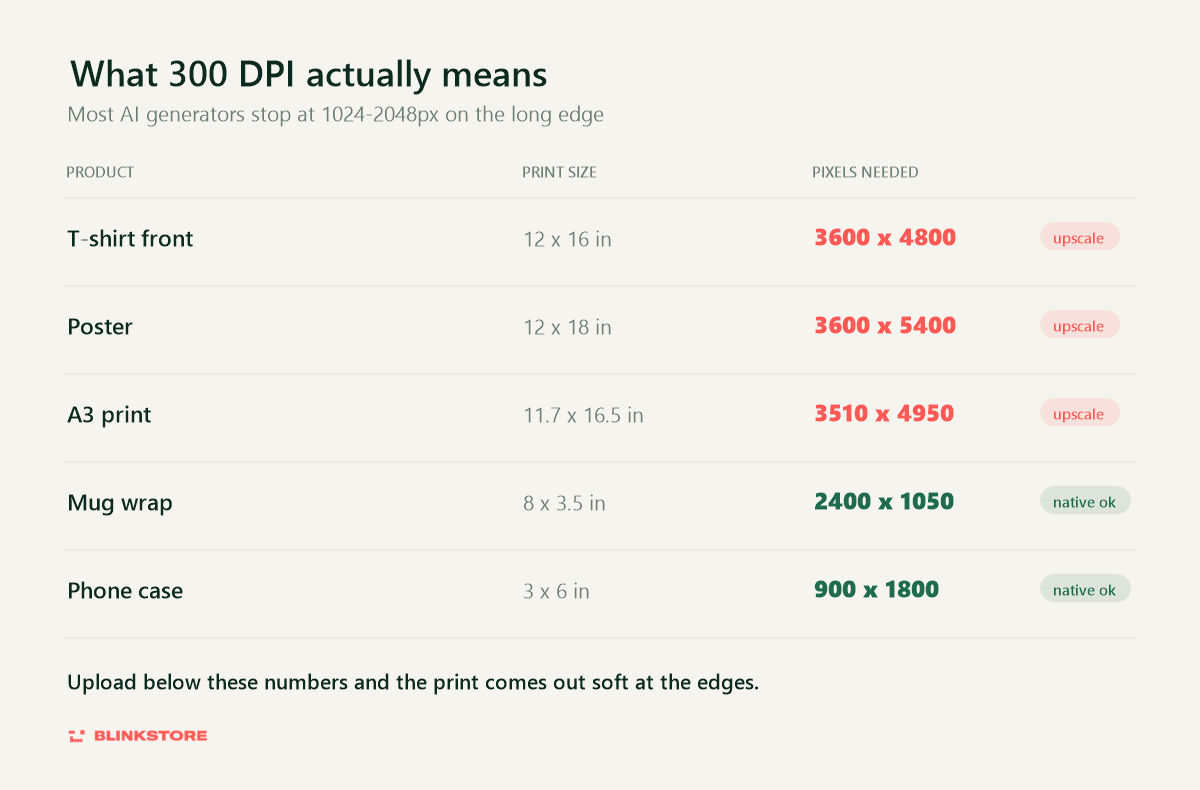
This is where most first attempts fail, and it has nothing to do with the art. Print needs roughly 300 DPI. Generators do not produce files anywhere near that size natively.
| Product | Print size | Pixels needed at 300 DPI |
|---|---|---|
| T-shirt front | 12 × 16 in | 3600 × 4800 |
| Poster | 12 × 18 in | 3600 × 5400 |
| A3 print | 11.7 × 16.5 in | 3510 × 4950 |
| Mug wrap | 8 × 3.5 in | 2400 × 1050 |
| Phone case | 3 × 6 in | 900 × 1800 |
Most generators give you something in the region of 1024 to 2048 pixels on the long edge. For a mug or a phone case that is fine. For a t-shirt or a poster it is roughly half of what you need, and the result prints soft and slightly blurred at the edges of the design.
- Upscale before you upload, not after. Most generators have a built-in upscaler; dedicated AI upscalers go further.
- Generate in the right aspect ratio from the start. Cropping a square image to 2:3 for a poster throws away pixels you needed.
- Check the edges and the hands. Print is unforgiving in a way a screen is not — artefacts you never noticed become obvious at A3.
- Do not use a transparent PNG for a listing image. On some marketplaces transparency renders as solid black.
- Preview on the actual product before listing. A flat image of the artwork converts far worse than the same artwork shown on a shirt or a wall; the tools are compared in 7 top t-shirt mockup generators.
What actually sells
AI removes the cost of producing a design, which means design is no longer the scarce thing. Distinctiveness is. The categories that work are the ones where a generic prompt cannot compete:
- Regional and cultural specificity. Madhubani, Warli, Pattachitra and Gond styles; temple architecture; city maps and skyline art for Indian cities.
- Occasion-driven sets. Diwali, Durga Puja, Onam, Pongal, wedding and haldi merchandise. Seasonal demand is predictable and you can build inventory-free ranges months ahead.
- Niche communities. Cricket, bikers, engineering and medical college humour, regional-language slogans, fandoms. These buyers pay for recognition, not for aesthetics.
- Corporate and bulk. Office merchandise, onboarding kits, event giveaways. Lower glamour, larger orders, far less competition.
What does not sell: undifferentiated “AI art” as a category. Buyers are not shopping for AI art. They are shopping for a poster they like.
How much can you actually make selling AI art?
Honestly: most people who try this make nothing, because they upload twenty designs, get no traffic, and stop. The ones who make money treat it as a product business rather than an art project.
The mechanics, though, are favourable. On print on demand your cost per unit is fixed by the printer and your margin is whatever you add on top, so profitability is a pricing decision rather than a volume gamble. On digital downloads there is no unit cost at all. Neither requires capital, which is the genuine advantage — you are spending time, not money, so the downside of a design that does not sell is an afternoon.
What actually determines the outcome is traffic. A design nobody sees earns nothing however good it is, which is why the sellers who succeed are usually the ones who already have an audience, or who set out to build one. We went through the arithmetic in is print on demand profitable in India, and how to sell art online in India covers the audience side.
A realistic first month
- Pick one niche and one product. Not “AI art”. Something like Warli-style prints for Maharashtra buyers, on posters.
- Generate ten designs, keep three. The discipline of discarding is the whole skill.
- Upscale to print resolution using the table above.
- Set up a store and list the three with proper mockups.
- Order one sample yourself. You cannot judge print quality on a screen, and you will need a real photograph.
- Drive traffic from one channel only, consistently, for four weeks.
- Read the numbers, then decide whether the niche or the traffic was the problem.
If you want to start on the print-on-demand side, Blinkstore gives you a free store you own, 50+ products and domestic fulfilment, so the only thing you are risking is the time it takes to generate the designs. Create your store free and list your first three.
AI has made the design step almost free. It has not made the business free, and it has not settled the law. Do the human work on both and you are ahead of most people trying this.
FAQs about selling AI art in India
Is it legal to sell AI art in India?
Yes. Selling AI-generated art is legal in India. What is restricted is authorship: in September 2026 the Copyright Office held that an AI system is not a natural or juristic person and cannot be named as an author under Section 2(d)(vi) of the Copyright Act, 1957. File as the human author and you are on solid ground.
Can AI-generated art be copyrighted in India?
Yes, if a human is named as the author. Section 2(d)(vi) of the Copyright Act defines the author of a computer-generated work as “the person who causes the work to be created”, which is the person writing the prompts and making the creative choices. Applications naming the AI as author or co-author are refused.
How can I sell AI art for free?
Use a print-on-demand platform with no monthly fee, or sell digital downloads. With print on demand you upload the design, the platform prints only after a sale, and you pay nothing upfront. Digital downloads cost nothing to deliver, so the only investment is the time spent generating and editing the artwork.
Can I sell AI art on Etsy?
Yes. Etsy does not ban AI art, but every listing must be “made, designed, handpicked or sourced by you”, and reselling mass-produced items is not allowed. AI work qualifies under “designed by you” when you did the actual design work, and you must declare any production partner that prints the item.
Can I sell AI-generated art on Amazon?
Yes, most commonly through Amazon KDP as low-content books such as colouring books, journals and puzzle books. KDP requires you to disclose AI-generated content at the point of publishing. Declaring it costs nothing; failing to declare it risks account termination.
How much can you make selling AI art?
There is no typical figure, and most sellers make nothing because they list a few designs and stop. The economics are favourable rather than automatic: print on demand has a fixed unit cost so your margin is a pricing decision, and digital downloads have no unit cost at all. Traffic, not design volume, decides the outcome.
Do I have to tell buyers my art is AI-generated?
It depends on the platform, and where disclosure is required it is not optional. Adobe Stock requires a generative-AI label on submission and Amazon KDP requires disclosure at publishing. Indian consumer law has no blanket rule for art, but misleading buyers about how a product was made creates unnecessary risk.
What resolution do AI images need for printing?
Around 300 DPI. A 12 x 16 inch t-shirt print needs roughly 3600 x 4800 pixels and a 12 x 18 inch poster needs 3600 x 5400. Most generators output 1024 to 2048 pixels on the long edge, so upscale before uploading or the print comes out soft.
